


Spent a bit reading this and what hit me is how early all of this still feels.
Everyone talks about agents executing tasks, but almost no one focuses on how they actually handle money once they do.
That gap is bigger than it sounds.
After reading the article is clear: agents can hold and move USD1, but every action runs through rules you set, signs locally, and only executes within those boundaries.
Even simple things like stopping a payment if funds are missing, or requiring approval above a threshold, are built in from the start.
That’s a very different approach compared to how most “agent” tools are being framed rn.

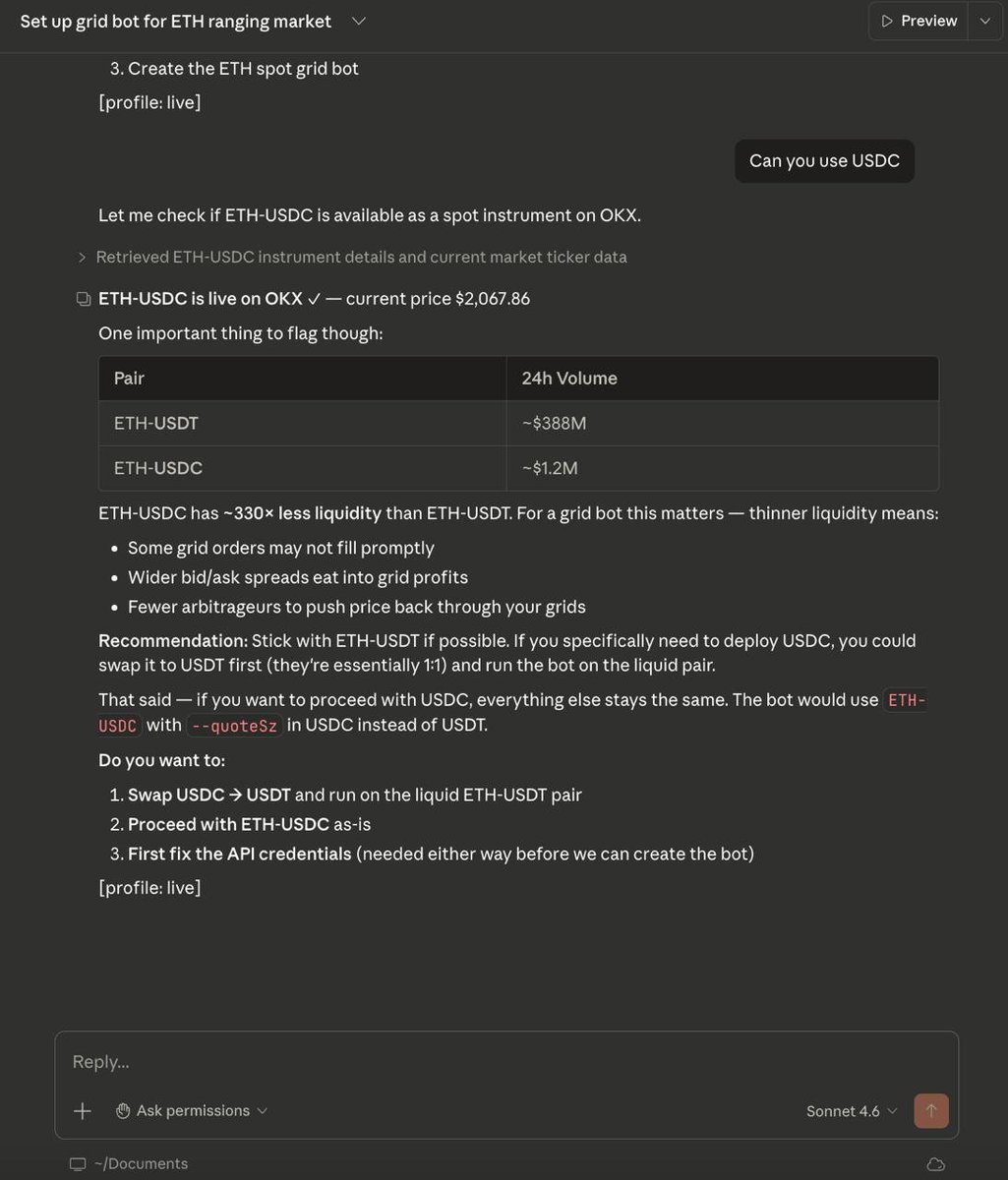
Typed one sentence. Got back a full weekly execution plan.
DCA into SOL every Monday, check the allocation, rebalance to 40% if it drifts.
All automated. @OKX Onchain OS.
This might be one of the strangest trades I’ve seen in a while.
Someone turned $250 into $626k… by tracking how often Elon Musk tweets.
No finance background. No trading experience.
Just a question: “how do I make money for my dream apartment?”
Somehow that led down a rabbit hole Polymarket, Musk’s posting habits, and a very specific edge.
Instead of guessing direction or chasing narratives, the idea was simple:
Watch how active Musk is early in the week.
Compare it to his usual behavior.
Then look at how the market is pricing his total weekly tweets.
If he’s already unusually active by midweek but the market still expects a low total… there’s a gap.
That gap was the trade.
No overcomplication. Just pattern recognition + execution.
Run it consistently, and somehow $250 compounds into $626k.
All from something as random as tweet frequency.
A few years ago, that sentence wouldn’t even make sense.
Now it sounds like a legit path to buying an apartment.
Markets really are getting weirder.
Everyone’s arguing over what’s next…
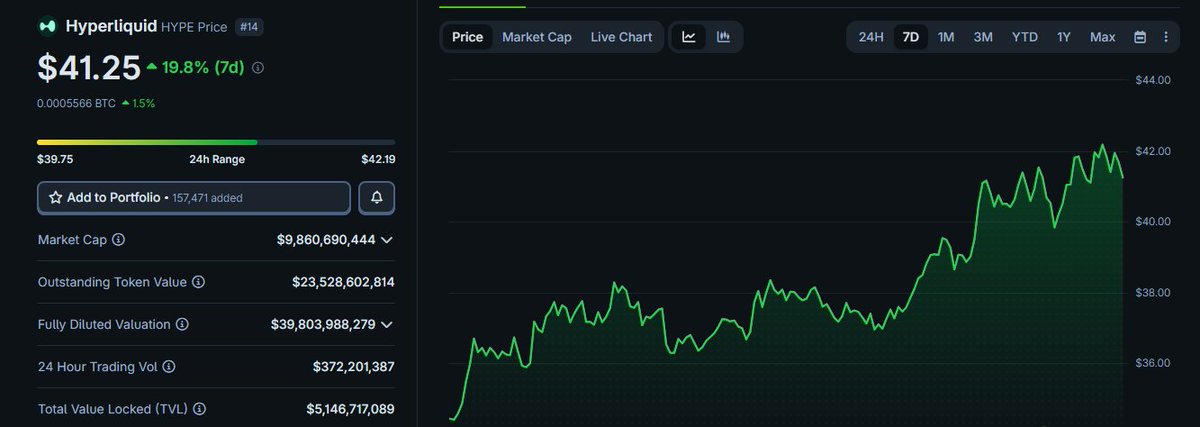
$HYPE already decided.
+20% in 7 days
while most of the market can’t even pick a direction.
No big announcements, no forced hype…
it’s just grinding up, step by step.
Every dip gets bought
every move actually sticks
that’s what stands out
This isn’t one of those charts that randomly spikes
and gives it all back the next day
it’s controlled
it’s patient
and it keeps pushing
funny thing is
people won’t care until it’s way higher
and then suddenly it’s “obvious”
seen this movie before.
one thing that becomes impossible to ignore after a while in this space is how predictable people are.
scroll the timeline long enough and a pattern appears.
when price goes up, the feed turns bullish.
when price goes down, the feed turns bearish.
not a little bit, almost entirely.
suddenly everyone has threads explaining why the pump will continue forever.
or why the dump was obvious and much lower prices are coming.
it’s like the opinion follows the candle.
once you notice this, something clicks.
most commentary online isn’t analysis.
it’s reaction.
people don’t form views and then watch the market.
they watch the market and then build views that match whatever just happened.
and honestly, it makes sense psychologically.
it’s comfortable to agree with the chart.
it’s comfortable to say what everyone else is already thinking.
being bullish on green candles feels safe.
being bearish on red candles feels rational.
but markets don’t reward comfort.
the accounts that are actually thoughtful the ones worth paying attention to often sound wrong in the moment.
they’re bullish when everyone is exhausted after a dump.
they’re cautious when the timeline is celebrating a huge pump.
not because they’re trying to be contrarian for attention.
but because real analysis isn’t tied to the last candle.
it requires emotional distance.
objectivity.
the ability to separate price movement from conviction.
that’s hard.
because when markets move fast, emotions move even faster.
fear during crashes.
euphoria during rallies.
most people simply mirror those emotions publicly.
so once you recognize the pattern, the timeline becomes easier to navigate.
you don’t need to argue with everyone.
you don’t need to correct every take.
you can just understand what you’re seeing.
reaction, not reasoning.
sometimes it’s best to ignore it.
sometimes it’s even useful as a counter-signal.
because the truth is, this game isn’t easy.
if it were, everyone reacting to candles would be rich.
instead, the real edge usually belongs to the few people capable of staying calm when the crowd is emotionally swinging in both directions.
something uncomfortable i’ve noticed about the “creator economy.”
most people who call themselves creators are still trapped in the exact same system they think they escaped.
they believe they’ve stepped outside of it.
no boss.
no office.
no 9–5.
but if you zoom out, a lot of them are just performing inside a slightly different version of the same machine.
posting constantly.
chasing engagement.
optimizing for algorithms.
feels productive.
feels entrepreneurial.
but the income often tells a different story.
many creators grind every day, producing endless content, yet barely make more than minimum wage when you actually break down the hours they put in.
and the strange part is they still see themselves as experts in the economy they’re trapped inside.
they analyze trends.
they comment on markets.
they explain systems.
all while being fully dependent on platforms that can change the rules overnight.
the reality is harsh, but simple.
content alone rarely creates freedom.
distribution matters.
ownership matters.
leverage matters.
if you’re building purely for engagement, you’re renting attention from an algorithm.
if you’re building an audience that trusts you, owns something with you, or follows you beyond one platform, that’s different.
that’s where the real shift happens.
the creator label by itself doesn’t mean independence.
in many cases, it just means you’ve taken on more work without the stability that traditional systems at least provided.
so the real question isn’t: are you creating?
the real question is: what are you actually building?
because there’s a big difference between producing content…
and building something that eventually stops depending on the machine you started in.
There’s one thing that rarely gets discussed in crypto.
How blockchain could fix broken accountability systems.
Take humanitarian aid.
More than $800B flows through the global aid ecosystem every year, yet estimates suggest over $320B is lost due to poor transparency, fragmented reporting, and outdated infrastructure.
That’s the problem @HumaTekGlobal is trying to address.
They’ve built HumaDash, a blockchain-powered SaaS platform that lets organizations and donors track donations in real time.
The idea is simple: if money can be tracked transparently, trust becomes verifiable instead of assumed.
The ecosystem runs on HumaCoin, which supports settlement and data tracking within the platform.
Interesting timing as well because the team will be present at the 2026 Oscars red carpet luxury gifting suite in Beverly Hills, pushing the idea of transparent aid infrastructure into more mainstream conversations.
If you’re curious about the concept, worth looking into what they’re building!

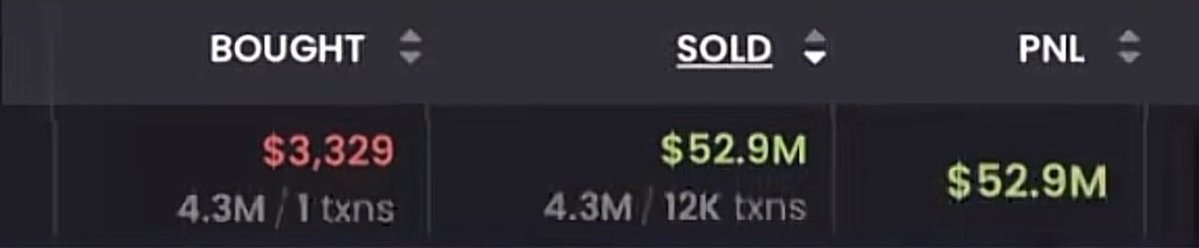
For anyone active in prediction markets, the Myriad update is a meaningful one.
Running fully on USD1 adds a new angle to the space.
Props to @farokh and the Myriad team.
I’m participating early cause if a token eventually comes out of this ecosystem, I’d rather already be involved.
Early interaction tends to matter more than people expect in these kinds of platform


A lot of good trench traders never scale.
Not because they’re bad, but because they’re trading too small or nuking their own wallets chasing size.
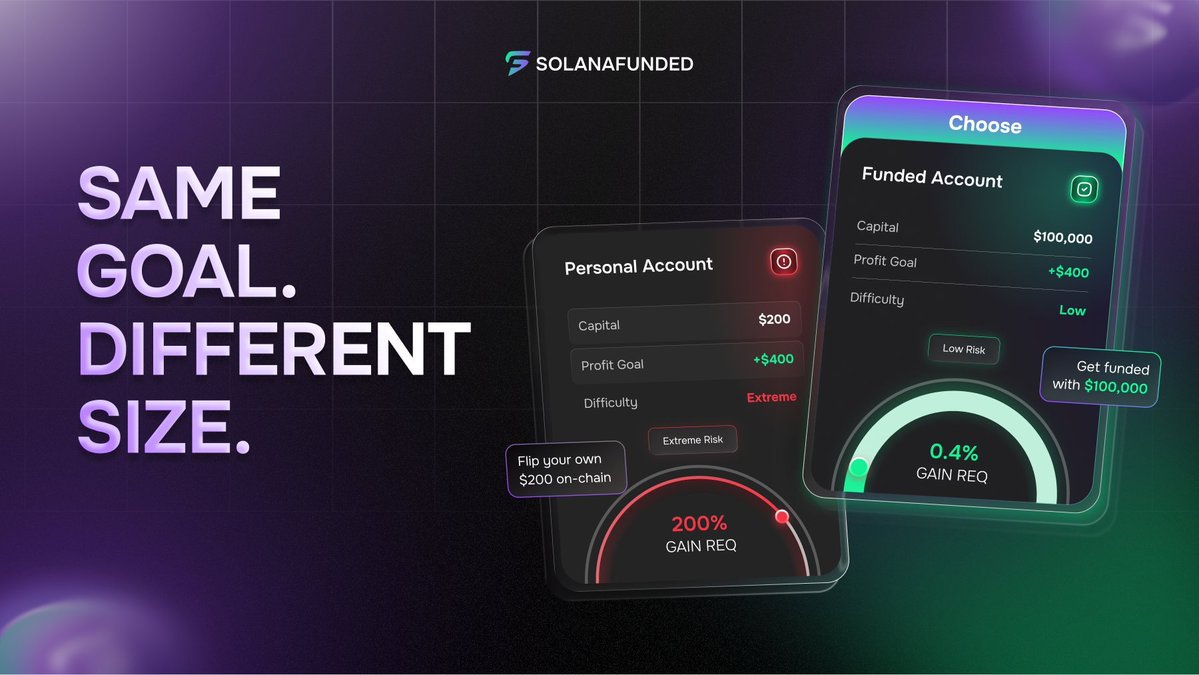
@solanafunded finally change that.
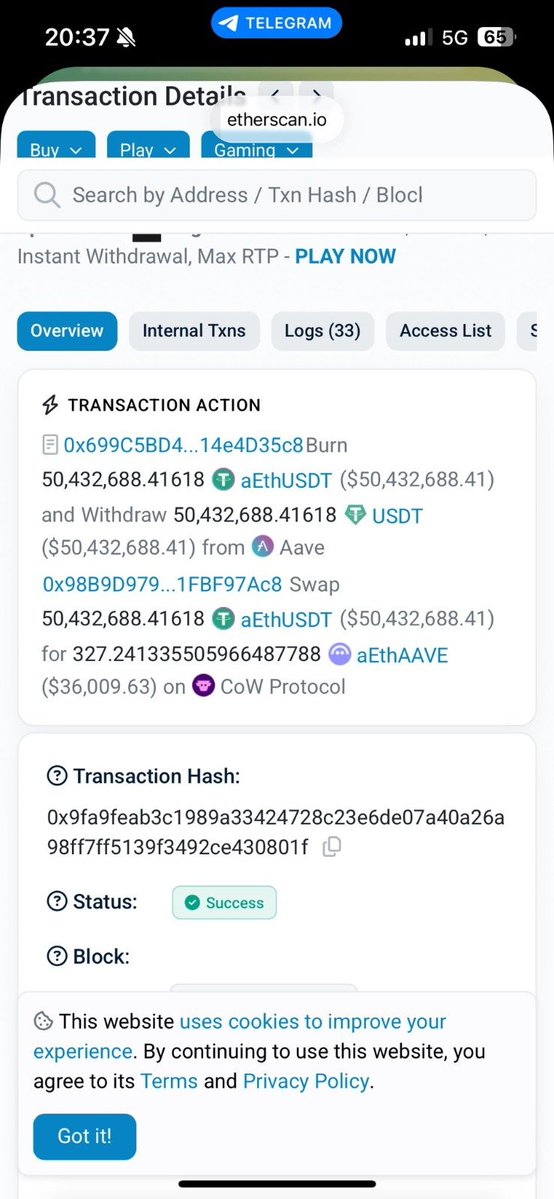
You pass an evaluation → get access to up to $100k funded capital to trade on-chain.
The cool part is their Solana Tap extension lets you use that capital on any terminal (Axiom, Photon, etc.)
And payouts are instant + on-chain.
Feels like something the Solana trenches needed for a long time.
🔗 If you’re a consistent trader but capital-constrained, it’s worth checking: https://t.co/P0gvTogt3K
⚠️ Disclosure: collaborating with SolanaFunded

A lot of good trench traders never scale.
Not because they’re bad, but because they’re trading too small or nuking their own wallets chasing size.
@solanafunded finally change that.
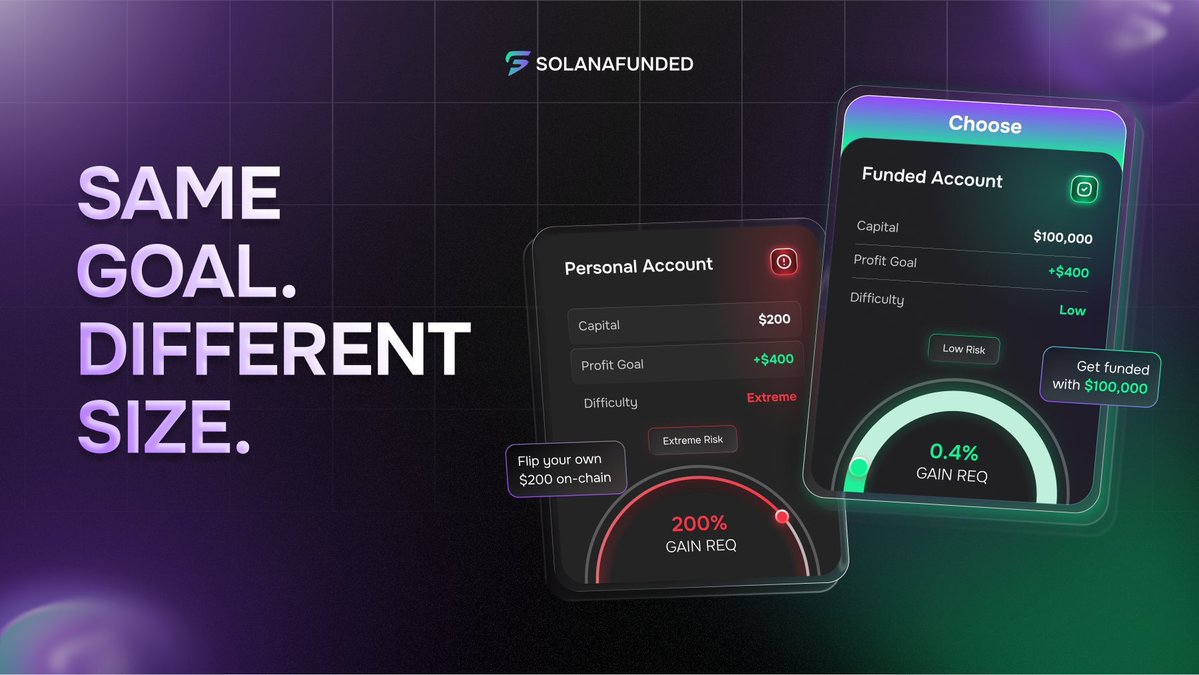
You pass an evaluation → get access to up to $100k funded capital to trade on-chain.
The cool part is their Solana Tap extension lets you use that capital on any terminal (Axiom, Photon, etc.)
And payouts are instant + on-chain.
Feels like something the Solana trenches needed for a long time.
🔗 If you’re a consistent trader but capital-constrained, it’s worth checking: https://t.co/hFcmIg9eAf
⚠️ Disclosure: collaborating with SolanaFunded
narrative signal: privacy had its breakout moment at ETHDenver and most of CT hasn’t priced it in yet.
Aleo launched @ShieldApp live, booth was overflowing, builder energy was undeniable.
when real products ship at real events with real crowds, that’s the signal you pay attention to. keeping an eye on this one.

🏔️ @EthereumDenver showed what’s possible when privacy moves from theory to reality.
From packed thoughtful conversations, to our packed booth and the launch of @ShieldApp, the energy around private, programmable applications has never been stronger.
Here’s a look back at the