


How Espresso Systems Works
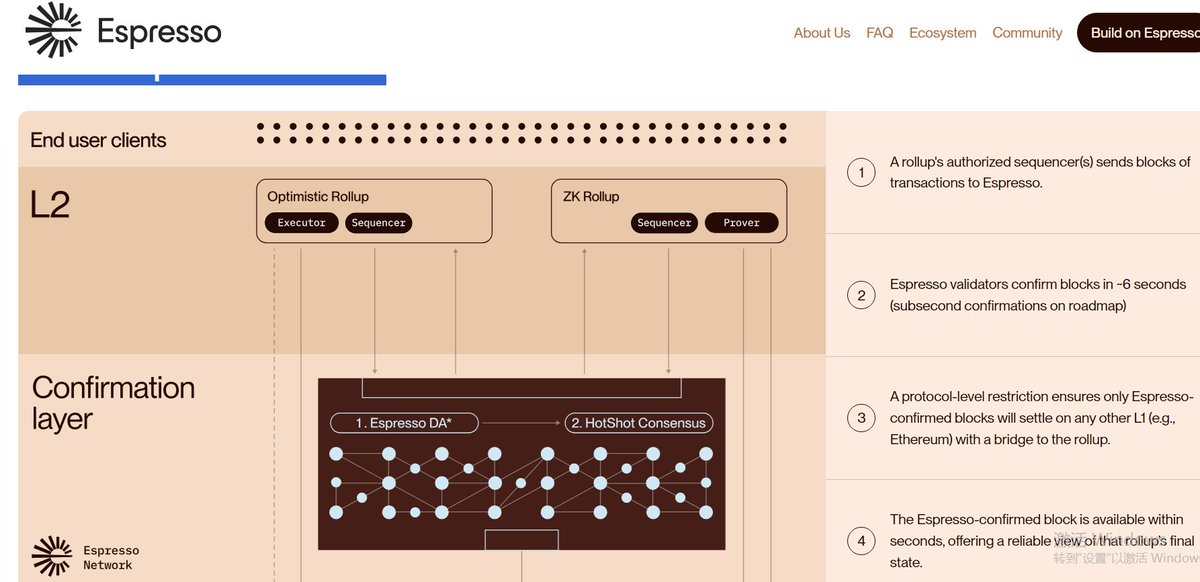
Espresso Systems (@EspressoSys) is building a shared infrastructure layer for rollups in the Ethereum ecosystem, focusing on fast transaction finality, cross-chain composability, and seamless interoperability. It acts as a "global confirmation layer" that enables rollups to confirm blocks in seconds (around 6s) without relying on slow L1 settlement, reducing risks like sequencer censorship or failures. This powers unified experiences across chains, like cross-chain order books or instant bridging, while maintaining Ethereum compatibility.
Core Components
Espresso's stack is modular and permissionless, designed for rollups (e.g., on Arbitrum, Optimism, or custom stacks). It doesn't execute transactions—that's the rollup's job—but provides secure ordering and data availability.
HotShot Consensus Protocol:
A Byzantine Fault Tolerant (BFT) consensus engine that finalizes transaction ordering across chains.
How it works: Rollup sequencers submit blocks of transactions to HotShot. Nodes (run by operators) vote on these blocks using a stake-weighted mechanism (soon integrating restaking via EigenLayer for shared Ethereum security). A quorum certificate (QC) is generated in ~6 seconds, providing "fast finality" that's economically enforceable.
Key properties: High throughput (up to 100k TPS in tests), low latency, and resistance to equivocation (e.g., a sequencer can't reorder blocks post-confirmation). It's optimized for partial synchrony, making it more efficient than full async BFT like Tendermint.
Stake table: Managed via L1 smart contracts (e.g., on Ethereum), updated per epoch (~1 hour) to include restakers, ensuring nodes read trustlessly.
Tiramisu Data Availability (DA) Layer:Provides cheap, scalable data sampling for rollup batches, ensuring data is available without full downloads.
How it works: Blocks are erasure-coded and distributed across nodes. Clients (e.g., rollup full nodes) sample proofs to verify availability in O(1) time, rather than downloading everything. This integrates with Celestia-like DA but is tailored for Espresso's consensus.
Benefits: Reduces costs for high-throughput rollups; supports validity proofs (ZK) or fraud proofs (optimistic).
Espresso Sequencer Marketplace:A decentralized auction system where rollups can outsource sequencing to specialized builders (MEV-maximizers) for better revenue and neutrality.
How it works: Chains bid for sequencing slots; winners propose blocks, which HotShot confirms. This minimizes centralization while enabling features like private mempools.
Transaction Flow (Step-by-Step)Here's how a typical cross-chain transaction processes through Espresso:User Submits Tx: A user sends a transaction to a rollup's sequencer (e.g., on Arbitrum Orbit chain).
Sequencer Proposes Block: The sequencer batches Txs and submits the block to HotShot for ordering.
HotShot Consensus: ~1,000+ nodes (permissionless) process the block via BFT voting. A QC is issued in <10s, confirming the order immutably.
Data Availability: Tiramisu ensures the block data is sampled and stored; rollups derive state updates via "Caffeinated Nodes" (modified full nodes that query Espresso RPCs).
Pre-Confirmation & Execution: Rollups provide instant pre-confs (e.g., 250ms) backed by Espresso's finality. Clients compute new states using the confirmed block—no waiting for L1 (10-15+ min).
L1 Checkpoint: Espresso posts a commitment (with QC) to Ethereum L1 for dispute resolution. If fraud is detected (rare), it's slashed via stake—not retroactive to execution.
Interop & Settlement: Confirmed blocks enable atomic cross-chain actions (e.g., via LayerZero bridges). For ZK rollups, proofs verify against Espresso commitments on-chain.
This flow trades off latency vs. trust: Users can act on Espresso finality immediately (low trust in sequencer) or wait for L1 (zero trust, but slower).Integrations & TestnetsStacks: Works with EVM (Arbitrum, Optimism), SVM, and custom VMs; bridges like LayerZero/Hyperlane.
Current Status: Mainnet live since 2025; testnets like Cappuccino (100 nodes) and upcoming Permissionless PoS emphasize decentralization.
Security: Audited (e.g., by Trail of Bits); economic security via staking/restaking; no single point of failure.
Espresso's vision: Make chains "work like one," ending fragmentation for apps like unified DEXs or CEX-like experiences on-chain.
@espressosys & @espressofndn @Bantr_fun $ESP


From X
Disclaimer: The above content reflects only the author's opinion and does not represent any stance of CoinNX, nor does it constitute any investment advice related to CoinNX.