


I’ve spent the past few days digging into what @nirvana_fi is building with Samsara, and I think it’s one of the clearest attempts I’ve seen to bring the “MicroStrategy playbook” fully on-chain—except this time it lives on Solana ($SOL) and runs on verifiable math, not boardroom discretion.
Here’s the gist in plain English:
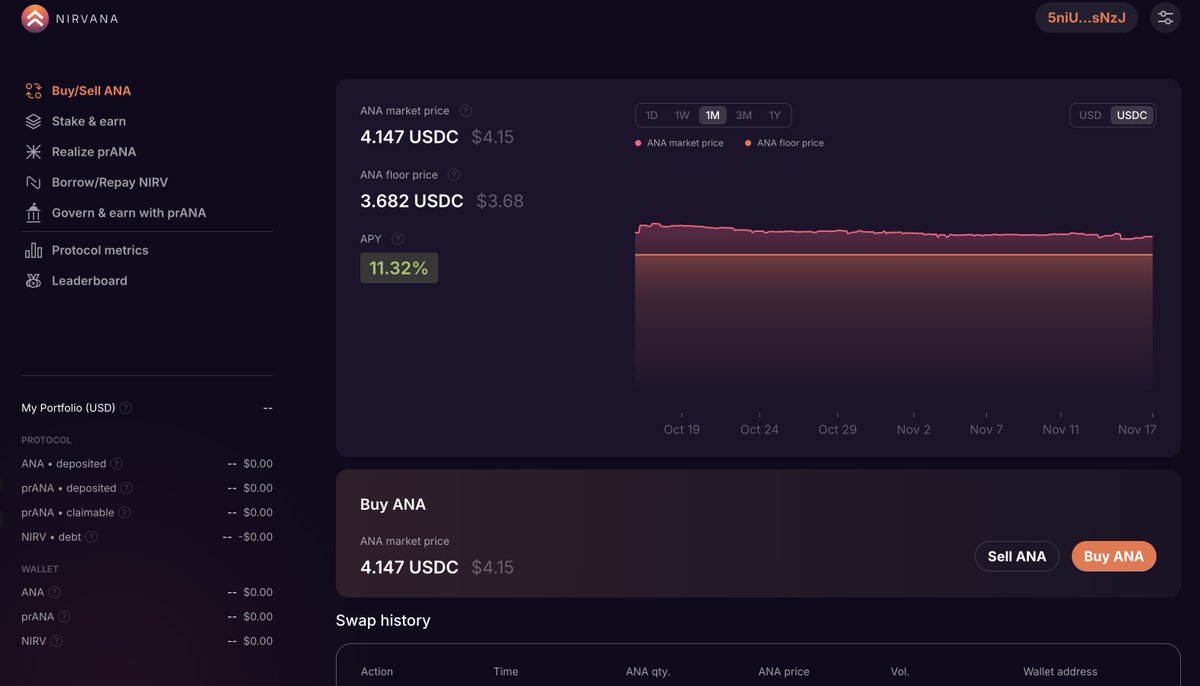
Nirvana is designing assets with a provable, redeemable floor that can only go up. That’s not marketing fluff; it’s encoded in a market engine they call the Assured Value Machine (AVM). The AVM powers two families of assets:
▪▫ $ANA (Nirvana’s foundational token), and
▪▫ datTokens (on-chain Digital Asset Treasuries—think “DAT companies,” but tokenized, transparent, and fair).
Why this matters
Traditional DATs (like MicroStrategy’s BTC approach) win attention because they amplify exposure to a base asset. But they also carry two structural issues:
1. shares can trade below treasury value (NAV discounts), and
2. you rely on centralized decisions (issuance, buybacks, treasury policy), often with insider allocations.
Samsara flips that script. Nirvana is creating the Samsara platform so any team can issue a decentralized DAT on Solana—same core idea as traditional DATs (accumulate a base asset to outperform it), but with on-chain redemption, transparent reserves, and no insider allocations. As a result, the floor is enforced by code and reserves, not promises.
The AVM in human terms
▪▫ Mint-on-demand. Each Assured Value Asset (AVA) is minted by depositing its reserve into the AVM. Example: datSOL is minted with SOL; datBONK is minted with $BONK. There’s no premine or presale; every token in circulation was purchased fairly from the curve, and redemptions burn supply.
▪▫ Deterministic price curve. The AVM sets price with a continuous, piecewise linear function (floor → shoulder → main curve).
▪ Buys move you up the curve (price rises).
▪ Sells move you down the curve, but never below the floor.
▪▫ Solvency invariant. Reserves are mathematically equal to the area under the curve up to current supply. When the system raises the floor, it reallocates area (liquidity) without changing the curve’s integrity. In other words: the protocol can always buy back 100% of supply at or above the floor.
▪▫ A floor that ratchets up. The floor price rises in two ways:
1. a portion of protocol fees is continuously injected into the floor, and
2. when liquidity above the floor is sufficient, the AVM automatically recalibrates the curve to push the floor higher.
Net effect: the minimum redeemable value only goes up.
This is the core promise: Nirvana created a floor-price guarantee for assets. It’s structural, not social—encoded and enforceable on-chain.
What Samsara unlocks
Samsara’s datTokens are essentially on-chain DATs: single-reserve, always-redeemable, and transparently priced by the AVM. They offer asymmetric profiles:
▪▫ Amplified upside via sustained, programmatic liquidity that deepens as supply grows.
▪▫ Capped downside because the redeemable floor is always there—backed by protocol-owned reserves.
This is the part that clicks for me: with Samsara, anyone can “be their own MicroStrategy” for any Solana-native asset. Want leverage-like upside on an asset you already love but with a mathematically enforced bottom? That’s the point of datSOL, datBONK, etc.
Where $ANA fits
$ANA is the first AVA and the value-capture token of the whole Nirvana ecosystem. It’s minted against USDC, inherits the same rising-floor mechanics, and sits at the center of governance and revenue:
▪▫ Stake ANA → earn prANA (governance & revenue share).
▪▫ prANA depositors vote on market parameters (fees, curve sensitivity, liquidity buffer) and receive a share of protocol fees.
▪▫ Borrowing is built in: users can mint the stablecoin NIRV against the ANA floor value, with zero interest and no liquidation risk. That last bit is only possible because the floor is always redeemable.
Put simply: activity across Samsara markets—trading, borrowing, exercising prANA—feeds protocol revenue, raises floors, and ultimately flows back into ANA’s value loop. It’s a flywheel.
A note on fairness and market structure
▪▫ No presales, no insider allocations. Supply only grows when someone mints by depositing the reserve.
▪▫ History is respected. Governance can adjust the curve’s slope (±10%), but only at the frontier of supply—past purchases keep their original depth.
▪▫ Liquidity buffer ensures meaningful sell depth above the floor at elevated prices.
▪▫ Floor recalibrations never violate solvency; the area under the curve is conserved.
All of this means the market’s microstructure is predictable and modelable. You’re not guessing what a market maker might do tomorrow; you’re interacting with a transparent function today.
Risks and reality
▪▫ Smart-contract and operational risk still exist. Complex math and governance need audits, monitoring, and time in the wild.
▪▫ UX and education matter. The “area under the curve” and “floor recalibration” concepts are powerful, but they’re not immediately intuitive to new users.
▪▫ Ecosystem dependencies (RPCs, infra reliability) on Solana are real—but the throughput/fee profile of $SOL is exactly what makes this kind of constant-liquidity design feel native.
My takeaway
Samsara reframes the DAT narrative from “story stock” to “engineered market”. You get:
▪▫ A mathematically enforced floor that only moves up,
▪▫ On-chain, protocol-owned liquidity that scales with demand, and
▪▫ A governance & revenue loop (via $ANA and prANA) that compounds activity into durable value.
If you’re already deep in Solana or you vibe with community assets like $BONK, datSOL and datBONK look like the next evolution of “higher beta” exposure—without sacrificing a redeemable bottom.
Bottom line: Nirvana is building Samsara to let teams issue decentralized DATs on Solana, with a floor-price guarantee and automated reserve acquisition. It’s transparent, fair, and—most importantly—structural. That’s what gives it a shot at enduring beyond market cycles.
@nirvana_fi $SOL $ANA $BONK $PUMP
From X
Disclaimer: The above content reflects only the author's opinion and does not represent any stance of CoinNX, nor does it constitute any investment advice related to CoinNX.