


Good at trading memecoins but felt limited by your own capital?
@solanafunded actually worth looking at.
They’re running a free 2-week Blitz competition.
You get a $25K challenge account, trade for 3 days, and compete for $350K in prizes.
Top prize is a $100K funded account. no entry fee. payouts are on-chain and verifiable.
They’re the only prop firm offering Solana coins for trading and have paid out $600K to traders already.
The competition is through their browser extension that lets you trade with their capital on any terminal you already use.
Worth entering just to feel what trading with real size is like.
🔗 Sign up here: https://t.co/AN5YXNStRx


SpaceX is valued at $1.5 trillion. most people will never get near it pre-IPO.
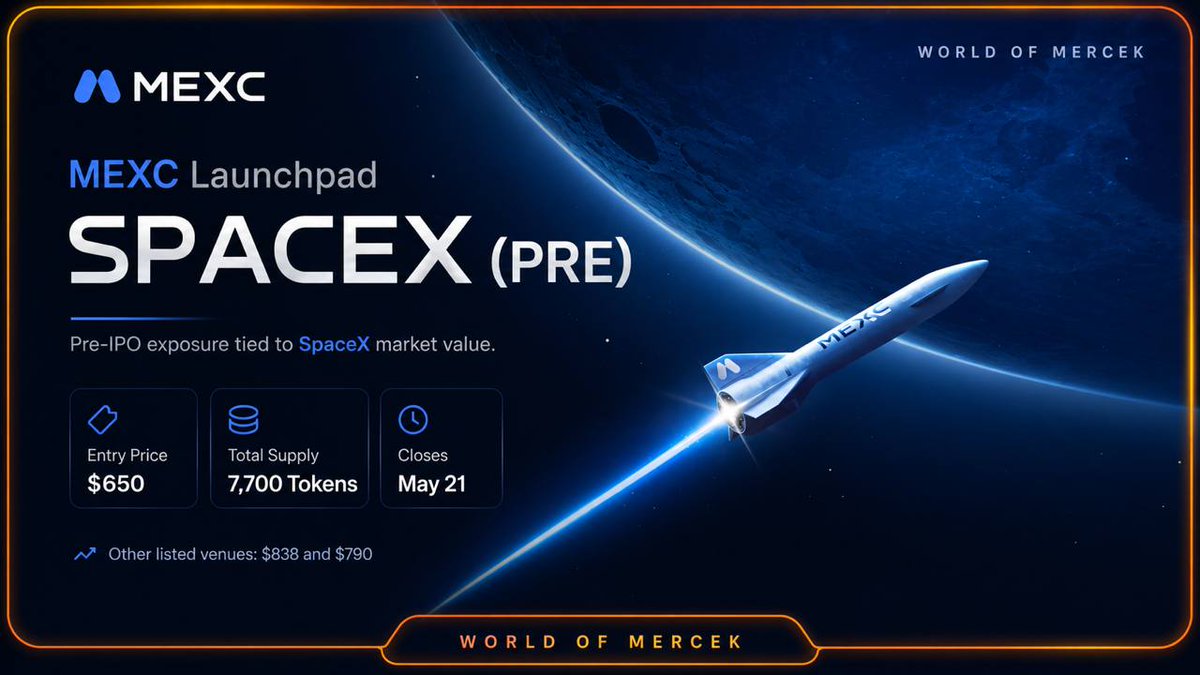
@MEXC recently opened a launchpad for SPACEX (PRE): a token that mirrors SpaceX market value.
The entry price is $650.
Exchanges that already launched the same product are trading it at $838 and $790.
MEXC is the only place still open at the original floor with 7,700 tokens total.
Smallest supply among major CEXs that launched this. smaller float plus listing day demand is a straightforward equation.
$650 disappears May 21.
After that you’re buying at whatever the market decides.
One thing that still feels massively underpriced to me is how early tokenized real world assets actually are.
People hear “RWA” and instantly think it’s just another crypto narrative.
But the bigger picture is much more important than that.
This is basically the financial system slowly migrating onto blockchain rails.
Treasuries, credit markets, commodities, stocks, real estate…
all becoming programmable, transferable and globally accessible 24/7.
And the growth curve is already starting to accelerate.
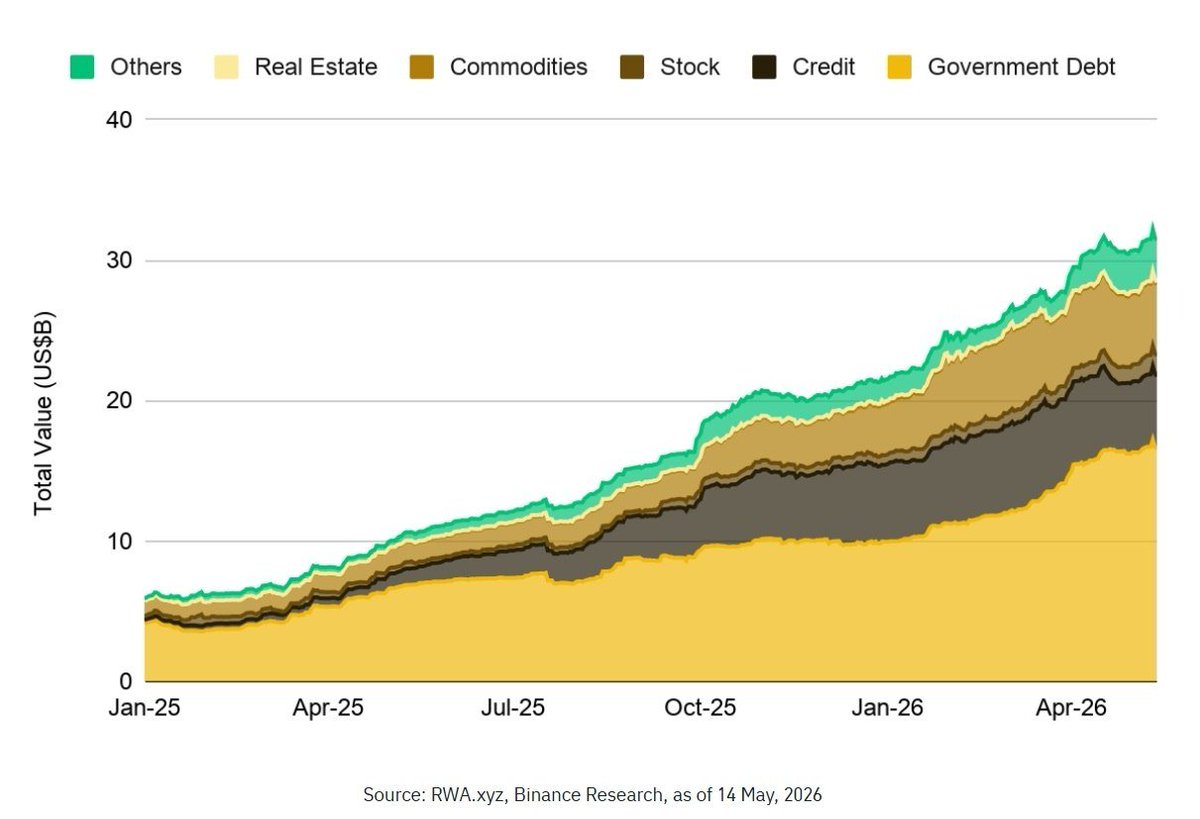
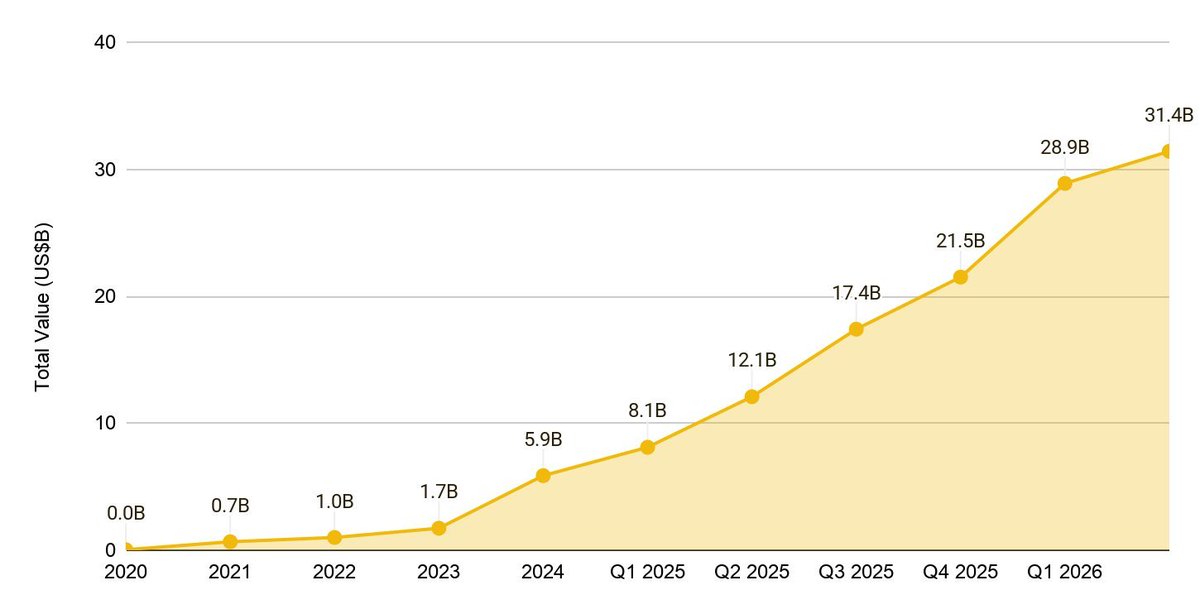
The tokenized RWA market has now reached $31.4B, with almost two-thirds of that growth happening within the last year alone.
Most of the capital entering first is obviously flowing into US Treasuries.
That makes sense.
Large institutions always start with the safest and most familiar assets before moving further out on the risk curve.
But after that, you already see expansion into:
→ private credit
→ commodities
→ equities
→ real estate
And honestly, the craziest part is how small this still is relative to global finance.
Even after this growth, tokenized assets still represent roughly ~0.01% of the global financial system.
Basically nothing.
That’s why I think many people are still misunderstanding the opportunity here.
The goal is not “launch more crypto tokens.”
The goal is rebuilding financial infrastructure itself in a more efficient format where markets never really close, transfers happen instantly, ownership becomes more accessible globally, and a lot of traditional friction slowly disappears over time.
And the important thing is that major institutions already see where this is going.
BlackRock.
JPMorgan.
Franklin Templeton.
They are not experimenting for fun anymore.
They are actively building on-chain financial infrastructure.
Which is also why I think the RWA sector probably becomes one of the biggest structural themes of the next few years.
If ETFs defined one phase of institutional crypto adoption, RWAs may define the next one.
On-chain US stocks are closer to mainstream than most people think.
@BitgetWallet is the first and only wallet with tokenized stock trading live across Ethereum, BNB Chain, and Solana at once.
NVDA, TSLA, 300+ more. $5 entry without broker, market hours or slippage surprises.
Until June 14th there’s a $100K competition running:
→ Volume-tiered rewards
→ Guaranteed payouts
→ No luck involved
And trading via Bitget Wallet stacks an extra 20% xPoints boost on top of everything else.
Get up to $264 in popular stock rewards like SanDisk!
🔗 The RWA infrastructure is here. might as well use it: https://t.co/JXr6fk7E1j

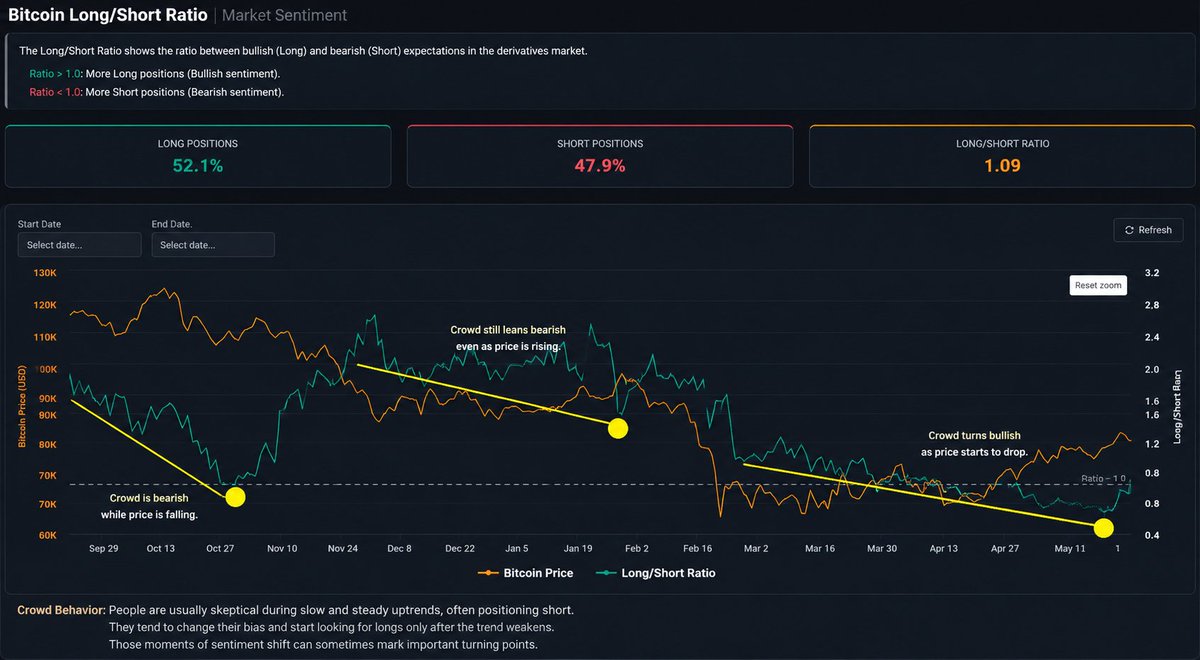
One thing I’ve noticed over the years is that crowds usually don’t trust slow uptrends.
Especially when price keeps grinding higher without explosive momentum.
During those periods, a lot of people keep looking for shorts the entire way up because the move never feels convincing enough emotionally.
Then after weeks or months of price slowly forcing acceptance, sentiment finally starts shifting.
The same people who spent the whole trend fading the move suddenly start thinking:
“okay maybe now I can finally long.”
Ironically, that shift in crowd positioning sometimes starts happening closer to exhaustion than initiation.
Not always of course.
But there are definitely moments where the market spends more energy convincing participants than actually moving.
And once the majority finally feels comfortable with the direction, the asymmetry often becomes much smaller than before.
The economic asymmetry in smart contract security has always been brutal.
An attacker spends an API call and a defender spends an engineer-week.
Formal verification was always the theoretically correct answer.
The reason it never scaled is that writing specifications by hand is slow and expensive.
What @wgrieskamp built destroy this barrier.
→ Claude Code plugs into the Move Prover via MCP
→ AI generates the specifications
→ The prover checks them mathematically
→ Refinement loops until verification passes
The tedious half gets automated while the rigorous half stays rigorous.
@DecibelTrade is the right target to prove this works: order matching, margin logic, liquidation, funding rates.
The full breakdown from @wgrieskamp is worth your time 👇🏻


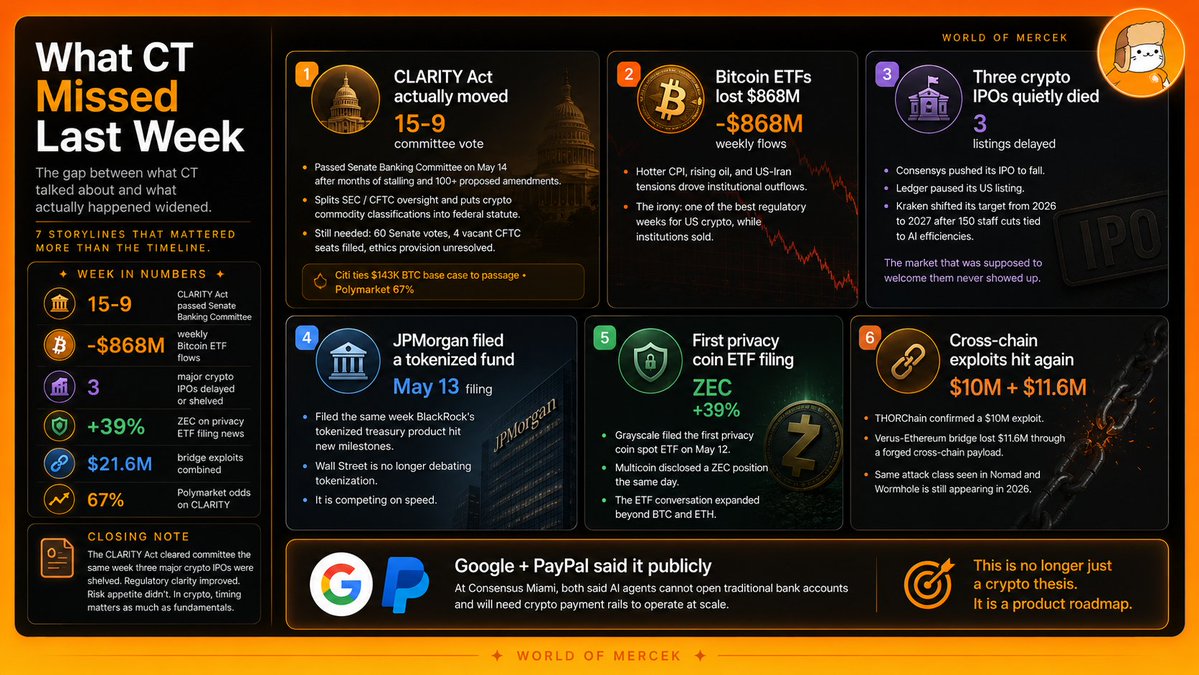
The gap between what CT was talking about last week and what happened has been wider.
Here’s what you may have missed from last week in crypto 👇
🗞 The CLARITY Act actually moved
After 100+ proposed amendments and months of stalling, the Senate Banking Committee passed the Digital Asset Market Clarity Act 15-9 on May 14.
The bill splits SEC/CFTC oversight of digital assets and writes crypto commodity classifications into federal statute.
What’s still needed:
→ 60 votes on the Senate floor
→ 4 vacant CFTC seats need to be filled before implementation
→ Ethics provision still unresolved: Democrats won’t vote without it, White House won’t accept anything targeting Trump specifically
Citi tied their $143K BTC base case directly to this bill passing. @Polymarket assigns it 67%.
─────────────────────
🗞 Bitcoin ETFs lost $868M in a week
Hotter-than-expected CPI. Rising oil. US-Iran tensions. Institutional investors pulled over $868M from Bitcoin spot ETFs across the week.
The irony: the most bullish regulatory week for US crypto in years, and institutions were selling.
🗞 Three crypto IPOs quietly died
@Consensys pushed its IPO to fall.
@Ledger paused its US listing entirely
@Payward (Kraken) shifted its target from 2026 to 2027 after cutting 150 staff citing AI efficiencies.
Three of the most anticipated public offerings in crypto, shelved in the same week.
The market that was supposed to welcome them never showed up.
─────────────────────
🗞 @JPMorgan filed a tokenized fund
Quietly, on May 13, JPMorgan filed to launch a new tokenized fund: the same week BlackRock’s tokenized treasury product crossed new milestones.
Wall Street stopped asking whether to tokenize assets. It’s now competing on who gets there first.
─────────────────────
🗞 Grayscale filed the first privacy coin ETF
First application for a privacy coin spot ETF has been filed May 12.
Zcash ($ZEC) posted 39% on the news.
Multicoin Capital disclosed a ZEC position the same day.
The ETF conversation just expanded beyond BTC and ETH for the first time.
─────────────────────
🗞 @THORChain confirmed a $10M exploit
Cross-chain infrastructure hit again.
THORChain confirmed a $10M exploit Saturday.
Verus-Ethereum bridge followed Monday with $11.6M drained via forged cross-chain payload.
Same attack class as Nomad ($190M) and Wormhole ($325M) from 2022 still happening in 2026.
─────────────────────
🗞 Google and PayPal said it publicly
At Consensus Miami, executives from both companies said AI agents cannot open traditional bank accounts and will need crypto payment rails to function at scale.
This is no longer a crypto thesis. It’s a product roadmap from two of the largest payment companies on earth.
─────────────────────
✍️ Closing note
The CLARITY Act cleared committee the same week three crypto companies quietly shelved their IPOs.
Regulatory clarity arrived. The market it was supposed to unlock hadn’t recovered yet.
Timing in crypto is everything: and sometimes the most important
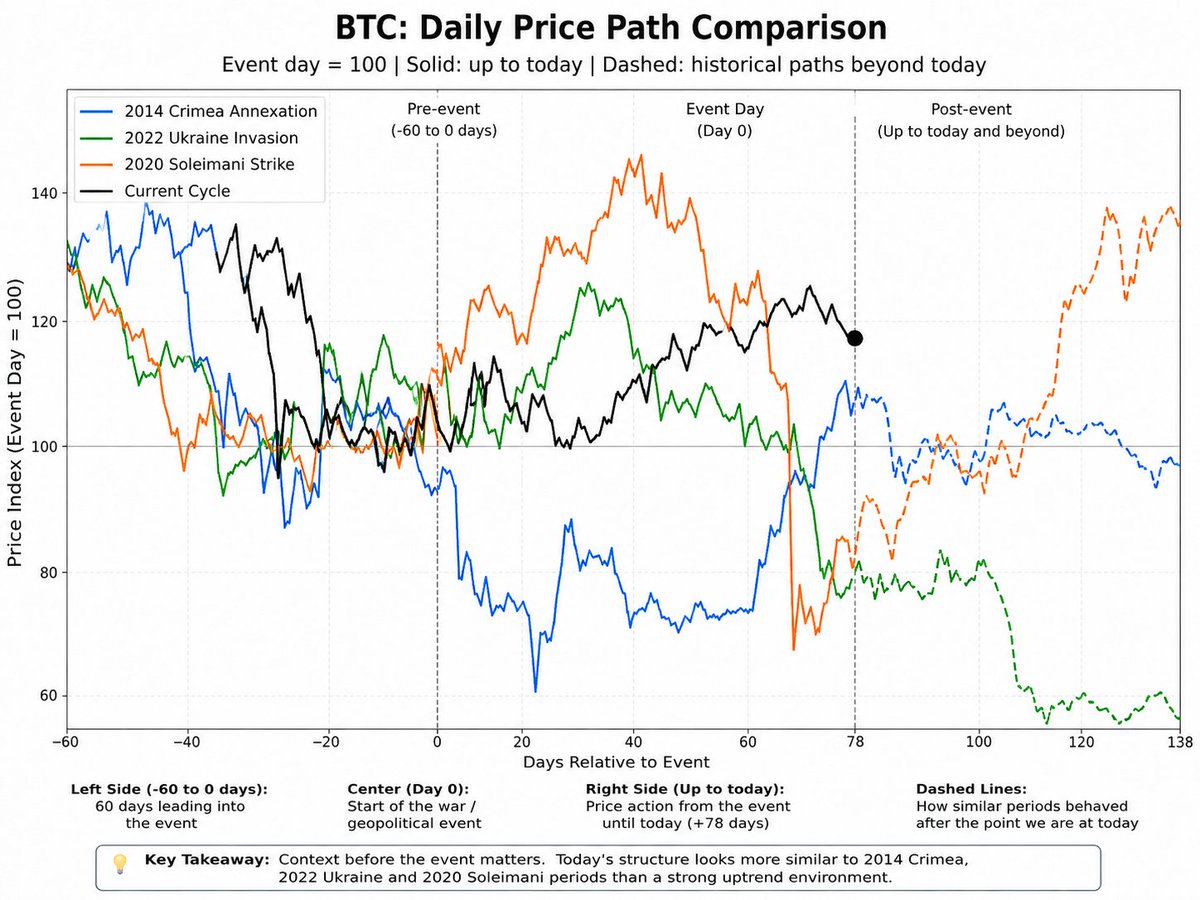
I think the more important question here is not the war itself, but the type of market structure BTC entered the event with.
Was Bitcoin already inside a strong trend when the conflict started?
Or was the market already losing momentum and showing signs of exhaustion beforehand?
That distinction matters a lot.
Because if you look at the 60 days leading into the event, the current structure does not really resemble a market in full expansion mode. Momentum was already fading and the market was starting to weaken before the geopolitical shock arrived.
That’s why the current setup probably looks closer to the 2014 Crimea annexation, 2022 Ukraine invasion and 2020 Soleimani period than people realize.
On the chart:
→ left side = 60 days before the event
→ middle = beginning of the war / geopolitical event
→ right side = price action up to today
The dashed extensions show how those historical periods continued afterward from roughly the same point we are currently at today.
Of course no historical analogue is perfect.
But market context before the event usually matters much more than the headline itself.
Not many stablecoins make it to tier-1 futures infrastructure this fast.
BTCUSD1 goes live today on @binance, 100x, with $USD1 already sitting at the highest collateral ratio tier across Portfolio Margin.
Quote currency, margin, collateral: three roles on the same venue simultaneously.
The integration depth is starting to speak for itself and we’re still early in the roadmap.
Quiet ones always build like this.

Polymarket basically confirmed that early creators and supporters may get rewarded.
So…
am i OG @Polymarket? 😄
I think one of the biggest mistakes people make is assuming their current life is their final form.
As if the person they are at 25, 35, or even 50 is supposed to stay permanent forever.
But if you look back honestly, even the last few years probably changed you more than you expected. Different goals, different mindset, different people around you, different priorities.
Life keeps moving whether you plan for it or not.
That’s why I never liked the idea that there’s an age where adventure, ambition, curiosity, or reinvention is supposed to end.
Some people build entirely new lives after losing everything.
Some discover the thing they’re truly good at way later than expected.
Some finally take risks once they stop caring about looking perfect to everyone else.
There’s always another chapter if you stay open to it.
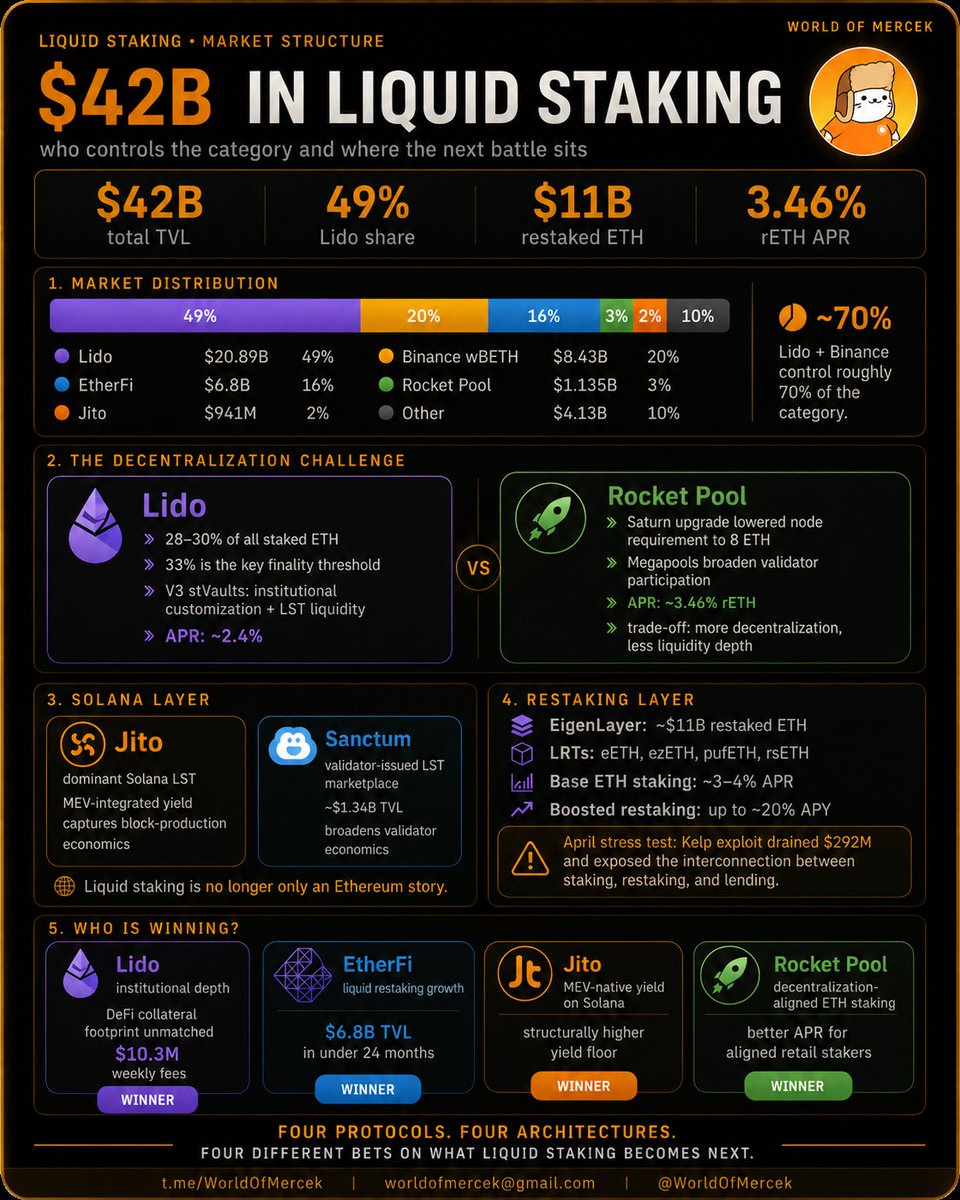
$42 billion...
That's how much capital is locked in liquid staking protocols right now.
More than lending. More than DEXs. More than any other single category in DeFi.
Here's how $42 billion actually distributes 👇
1️⃣ Market Distribution
@LidoFinance holds $20.89 billion:
$42 billion...
That's how much capital is locked in liquid staking protocols right now.
More than lending. More than DEXs. More than any other single category in DeFi.
Here's how $42 billion actually distributes 👇
1️⃣ Market Distribution
@LidoFinance holds $20.89 billion: roughly 49% of the entire liquid staking market.
That's near-monopoly territory in a category worth $42 billion.
→ @binance Staked ETH (wBETH) sits second at $8.43 billion
→ @ether_fi at $6.8 billion
→ @Rocket_Pool at $1.135 billion
→ @jito_sol at $941 million in pure liquid staking TVL
The concentration at the top is more extreme than most DeFi analytics suggest.
Lido and Binance together control roughly 70% of the category. The remaining $12 billion is split across dozens of protocols.
That concentration is the most important structural tension in liquid staking right now and it's being actively contested from two directions simultaneously.
──────────────────────────────
2️⃣ Decentralization challenge
Lido controls an estimated 28-30% of all staked ETH on Ethereum.
Over dominance, this is a meaningful influence over Ethereum's validator set.
The Ethereum Foundation and core developers have raised this concern explicitly.
If Lido crosses 33% of staked $ETH, it gains theoretical influence over Ethereum's finality mechanism.
→ Lido's response is Lido V3: stVaults, a new architecture that allows large-scale institutional stakers to select specific node operators and customize their risk profile while maintaining LST liquidity.
It's a product designed to compete with solo staking from institutions who want customization without giving up composability.
Rocket Pool took the opposite approach.
→ The Saturn upgrade reduced the ETH requirement to run a node to 8 ETH and introduced megapools.
The result is a genuinely more decentralized validator set, at the cost of depth of liquidity.
→ Rocket Pool's rETH currently offers approximately 3.46% APR versus Lido's 2.4%.
──────────────────────────────
3️⃣ Solana layer
The Ethereum-centric view of liquid staking misses what's happening on Solana.
Jito is the dominant Solana liquid staking protocol and its differentiation is not just size.
→ Jito integrates MEV optimization directly into its staking mechanism, capturing additional value from transaction ordering and passing it back to JitoSOL holders on top of the base Solana staking yield.
That structural advantage guarantees yield from block production economics, not just consensus rewards and makes it a different product from stETH.
→ Sanctum's Validator LST model goes further.
Rather than a single monolithic LST, Sanctum lets individual Solana validators issue their own liquid staking tokens, creating a marketplace of LSTs at $1.34 billion TVL.
The model distributes validator economics across a much broader set of participants — and it's the most interesting architectural experiment in liquid staking that almost no one outside Solana is tracking.
──────────────────────────────
4️⃣ Restaking layer on top
EigenLayer represents $11 billion in restaked ETH
EtherFi's eETH, Renzo's ezETH, Puffer's pufETH, and Kelp's rsETH are all liquid restaking tokens: LSTs extended one layer further into AVS security.
→ Base Ethereum staking yields approximately 3-4% APR.
→ Restaking adds AVS rewards on top, paid in the AVS's own token
→ EtherFi has advertised up to 20% APY through boosted restaking
The Kelp DAO exploit in April was a stress test for exactly this architecture.
rsETH's cross-chain bridge vulnerability drained $292 million and triggered a $12 billion Aave TVL crash in a week.
The interconnection between liquid staking, restaking, and lending markets created cascading exposure that wouldn't have existed without the composability layer.
The DeFi United recovery fund and the Aave emergency response were the sector's response.
──────────────────────────────
5️⃣ Who is winning
The headline answer is Lido. The more interesting answer is that three different protocols are winning three different things simultaneously.
→ Lido is winning institutional depth: stETH is accepted as collateral on Aave, MakerDAO, Morpho, and dozens of lending protocols. It generates $10.3 million in fees every seven days. The DeFi integration footprint is unmatched.
→ EtherFi is winning the liquid restaking category: the only protocol that combines liquid staking, restaking, a crypto credit card, and institutional yield in a single product surface. It grew from near-zero to $6.8 billion in TVL in under 24 months.
→ Jito is winning the MEV-integrated yield category on Solana: a structurally higher yield floor than any Ethereum LST because it captures block production economics directly.
→ Rocket Pool is winning the decentralization-aligned ETH staker: and quietly delivering a better APR than Lido for retail participants who understand the product.
Lido, EtherFi, Jito, Rocket Pool are four different bets on what liquid staking becomes.
Which one is building for the cycle after this one?
Prediction markets have always had the same ceiling.
Human bias, slow information processing, and liquidity that dries up the moment things get interesting.
@NeoSoulAI is building something structurally different.
An AI-native prediction market where agentic oracles process and resolve information faster and more accurately than any human curation layer could.
The network learns from every outcome and evolves its own resolution logic over time.
The self-evolving network angle is the part worth paying attention to.
Most prediction markets are static infrastructure. NeoSoul’s architecture gets smarter with every market that closes.
AI agents making probabilistic judgments on real-world events, with a network that improves its own accuracy autonomously.
The timing is right, prediction markets are having their moment and the infrastructure layer is still wide open.
Early enough to matter.

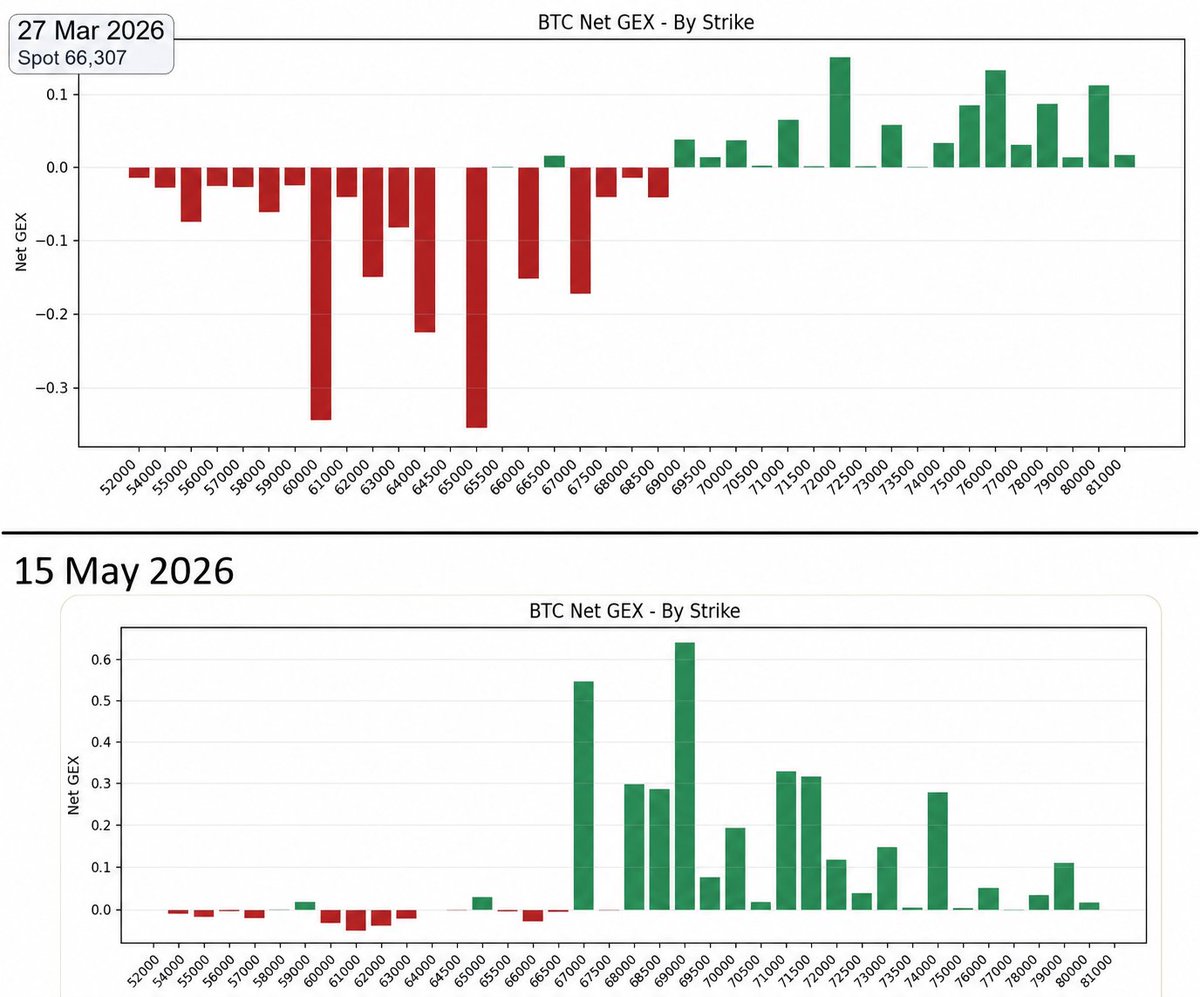
One thing I always find interesting in Bitcoin is how different the narrative sounds once you look at positioning instead of headlines.
Back on March 27, BTC options positioning was heavily skewed toward downside protection.
The market was hedged for bad news.
Fear was already priced in.
Which also meant one important thing:
If conditions stopped getting worse, those downside hedges could unwind and actually help fuel upside momentum.
Today the picture looks very different.
The positive gamma side is much heavier and much cleaner across higher strikes.
In simple terms, the market is no longer positioned for disaster.
It is positioned for good news.
And that changes the game completely.
Because once the market starts leaning bullish, “good” news alone is not enough anymore. Expectations move higher too.
That’s why I think social media narratives alone are never enough.
People constantly say Bitcoin will go higher or lower.
But the more important question is:
Has real money actually positioned for that scenario already?
GEX tables are useful because they help show where expectations stopped being opinions and started becoming positioning.
Something about $HOTEMIN genuinely feels like old AVAX again 😭
Not even talking about the token itself yet.
Just the energy.
The memes are spreading everywhere, old avalanche users suddenly woke up again, timelines are getting chaotic, and everyone is trying to secure an allocation like it’s 2021 all over again.
That’s the thing people outside AVAX never understood.
Avalanche presales were never just “buy token and wait.”
It was culture.
Competition.
Memes.
Timeline wars.
Pure chaos.
And honestly… some of the most absurd runners came out of exactly that environment.
Now suddenly all of that energy is coming back around $HOTEMIN.
If this thing fully catches momentum, people will pretend it was obvious later.
But right now it still feels early enough to be fun.
@nobsfud
we’re ready for hot emin summer 🔺🔥

Went a bit deeper into the rabbit hole with @OlympusXReserve.
And it kept my attention for how the treasury compounds.
➜ Validator yield (stETH) running in the background
➜ Sell-side flow continuously adding ETH
➜ Supply getting reduced over time
So, you end up with a system that doesn’t rely only on inflows to sustain itself
For me it’s closer to an onchain ETH treasury loop than a typical token
Not financial advice, still early-stage risk
But curious how many are starting to look for designs that hold up under sell pressure.

There is a level of money that changes your life, but does not fully set you free.
That is probably one of the weirdest stages.
You are not broke anymore. You can breathe, make better choices, pay things off, travel, buy nicer things, and stop feeling every small expense in your body.
But you are also not truly done.
Not if you are young. Not if you still have decades ahead. Not if housing, healthcare, taxes, inflation and lifestyle costs keep moving faster than people want to admit.
So the number feels big and small at the same time.
Big enough to prove you are on the right path.
Small enough to remind you that the game is not over yet.
$28 TRILLION!!!
That's how much value moved through stablecoins in Q1 2026 alone.
For context: Visa processes roughly $12 trillion annually. Stablecoins did more than double that in 90 days.
Let's frame it properly 👇
1️⃣ Reaching $317 billion
The stablecoin market crossed $300 billion for the first time in late 2025. It hit $320 billion in April 2026. It sits at $317 billion today.
Supply grew by nearly $100 billion in 2025 alone: more than the previous two years combined.
Stablecoin issuers are now the 7th largest holders of US government debt.
The asset class that started as a trading tool has become a structural pillar of global liquidity.
The composition of that $317 billion tells you where it's actually going.
──────────────────────────────
2️⃣ The two-tier market
✚ $USDT holds $185 billion with 58% dominance across 126 chains.
It is the dollar for emerging markets, exchange settlement, and cross-border transfers where correspondent banking is too slow.
✚ $USDC sits at $78 billion. Its 2026 story is becoming the settlement currency for institutional infrastructure: Coinbase x402, Amazon Bedrock AgentCore and more.
Every major regulated infrastructure play in the past 90 days runs on USDC.
Then there is a third category that barely existed 18 months ago.
──────────────────────────────
3️⃣ The yield-bearing layer
✚ $USDe peaked at $9.3 billion in August 2025 after the GENIUS Act triggered institutional inflows.
It has since contracted to approximately $5.9 billion as funding rates compressed during a deleveraging period.
The 7-day trailing APY on sUSDe sits at 9.4%. The 90-day trailing average is 11.8%.
The $5.9 billion that stayed through the compression is the signal. Those holders understand the mechanism and are not leaving for T-bill yield at 4.5%.
✚ BlackRock's BUIDL: tokenized money market fund, T-bill yield onchain is now integrated into Ethena's reserve collateral mix, UniswapX, and Aave.
It is not competing with USDC or USDT. It is the yield layer underneath them.
✚ Sky (formerly MakerDAO) earns 60% of protocol revenue from RWA collateral. The largest decentralized stablecoin protocol on Ethereum has already restructured itself around this reality.
──────────────────────────────
4️⃣ Three functions that define 2026
$28 trillion moved through $317 billion in stablecoin supply in Q1. That velocity means stablecoins are now functioning as three distinct things simultaneously.
✚ Settlement currency: exchange trading, DeFi, cross-border payments. USDT owns this by distribution.
✚ Institutional rails: tokenized securities, AI agent payments, corporate treasury, regulated infrastructure. USDC is the default here by design.
✚ Yield instrument: for protocols, DAOs, and sophisticated users who want dollar-denominated yield from crypto-native mechanisms. USDe, sUSDe, and BUIDL are the infrastructure of this category.
The mistake most analysis makes is treating these as competing products. They are three layers of the same infrastructure stack.
──────────────────────────────
5️⃣ Most important numbers
75% of total crypto trading volume in Q1 2026 was denominated in stablecoins.
Not Bitcoin. Not ETH. Stablecoins.
The GENIUS Act called them payment stablecoins. Amazon is building enterprise infrastructure on them. The ECB is threatened enough to tell Europe to build something else.
Stablecoins stopped being a tool a long time ago.
But has the market really caught up to what they actually became??
“Once I make enough money, I’m done with crypto forever.”
I’ve heard some version of that sentence for years now and almost nobody actually means it.
A lot of traders, founders, and investors eventually reach numbers they once dreamed about, disappear for a while, then quietly return to the charts again a few months later.
Because at some point this stops being only about financial upside.
You get addicted to the pace of it.
The constant evolution.
The competition.
The feeling that every cycle creates entirely new opportunities if you stay sharp enough to see them early.
And honestly, doing absolutely nothing sounds exciting for maybe a few weeks until your brain realizes it spent years operating inside one of the fastest-moving industries in the world.
That’s why so many “retired” crypto people somehow end up back here again.
Not always because they need the money.
Sometimes they just miss the game itself.
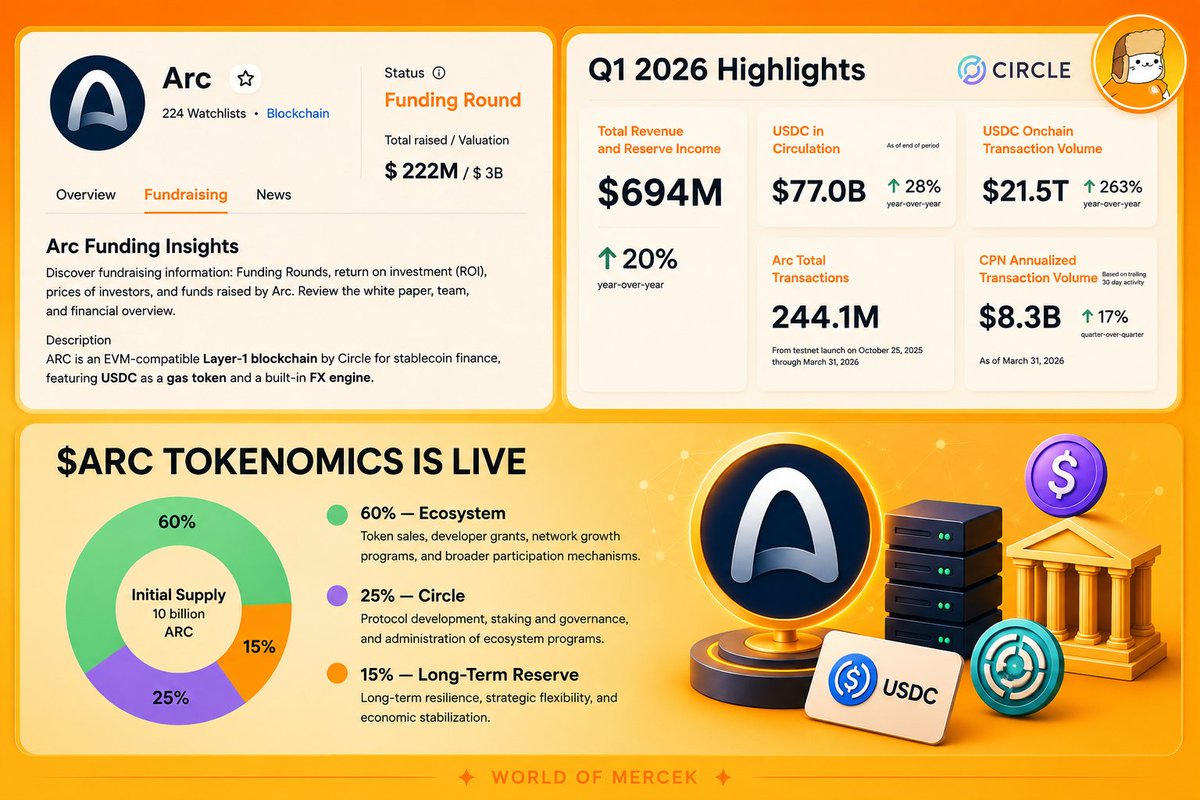
Circle quietly made one of the biggest infrastructure bets in crypto.
@arc just raised $222M at a $3B valuation.
A16Z, ICE, ARK Invest, Apollo, BlackRock and others are now backing a new Layer 1 built around stablecoin finance.
Most people will probably look at this and immediately ask:
“will there be an airdrop?”
But I think the more important question is what Circle is actually trying to build here.
Because Arc does not look like another generic Layer 1 narrative.
It looks more like Circle trying to turn USDC into native financial infrastructure.
That distinction matters.
Circle already has:
→ $77B+ USDC in circulation
→ $21.5T onchain transaction volume
→ massive distribution across exchanges, fintechs and institutions
Now they are pushing deeper into:
→ payments
→ AI agents
→ onchain settlement
→ stablecoin-native finance
→ real world financial rails
And Arc seems designed specifically for that direction.
Even the architecture feels different from the usual crypto cycle narratives.
USDC as gas.
Built-in FX engine.
Heavy focus on payments and financial applications instead of meme throughput wars.
The tokenomics also say a lot.
→ 60% goes to the ecosystem
→ 25% to Circle
→ 15% reserved for long-term stability
To me, that allocation signals they care more about growing network activity and developer infrastructure than creating short-term hype.
Which is also why I doubt this becomes one of those ecosystems where people farm 20 transactions and disappear.
If Arc rewards early participants at some point, I think the network will care much more about:
→ builders
→ apps
→ payment integrations
→ AI tooling
→ community contribution
→ real usage
not meaningless wallet activity.
Especially now that the ecosystem became much more competitive after the $222M raise.
The interesting part is that Circle may be positioning Arc exactly where crypto, stablecoins and AI agents start overlapping.
And honestly, that might end up being one of the most important sectors of the next cycle.
People keep saying crypto is dead, but the data is telling a slightly different story.
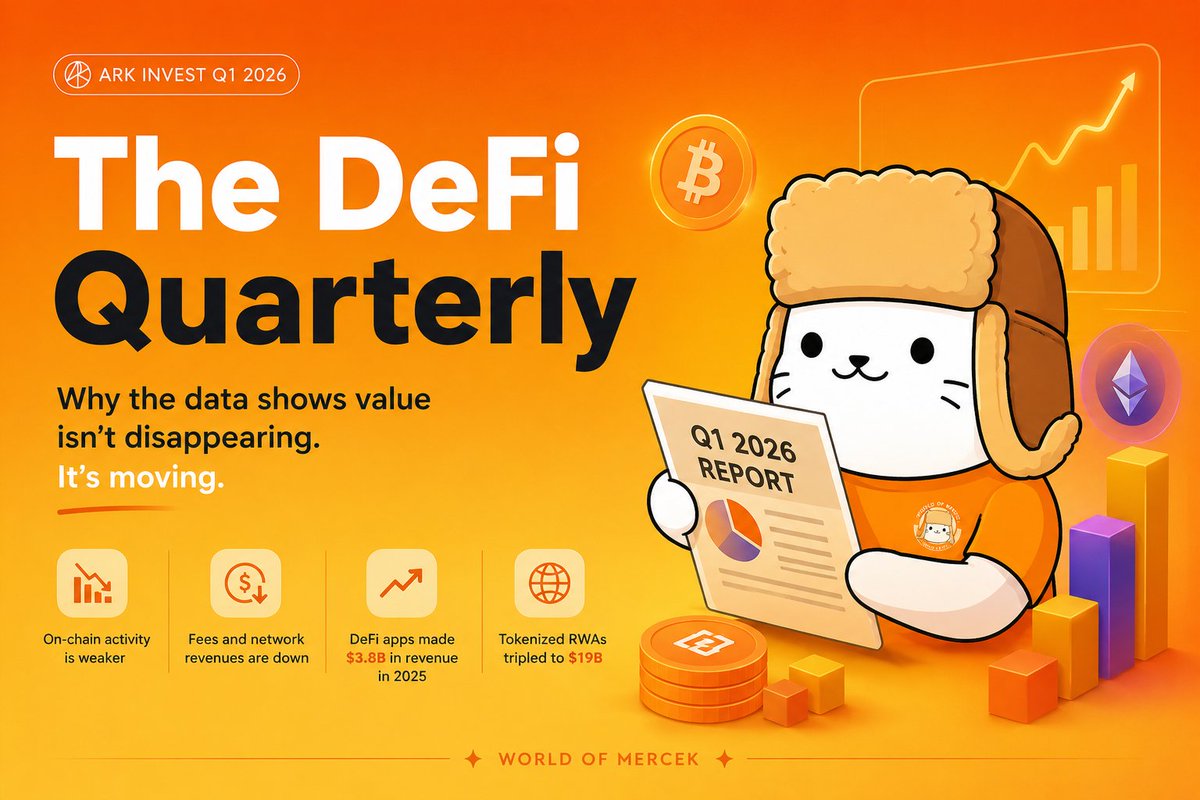
On-chain activity is weaker. Fees are down. Network revenues are at their lowest levels since 2022.
But applications are still making money.
According to ARK Invest’s Q1 2026 report, DeFi TVL pulled back, yet DEXs gained market share and DeFi apps generated a record $3.8B in revenue during 2025.
That is the important part.
The value is not disappearing. It is moving.
For years, the market focused mostly on infrastructure: Layer 1s, Layer 2s, blockspace, throughput and scalability.
But infrastructure gets competitive over time. Fees compress, margins shrink, and the market starts asking a different question:
Who actually owns the users, the liquidity and the transaction flow?
That is where applications become more important.
Tokenized real world assets also tripled to $19B in 2025, which shows the same broader pattern.
Crypto is not just waiting for another speculative cycle. Some parts of it are slowly turning into actual financial infrastructure.
Maybe the next phase is less about betting on every new chain and more about finding the apps people keep using when the hype cools down.
A few years ago, companies like MARA, Riot, HIVE, Hut 8, TeraWulf and Cipher were mostly followed as Bitcoin miners.
Now look at how they present themselves.
→ Energy infrastructure.
→ Data centers.
→ HPC.
→ AI compute.
→ Power capacity.
→ Hyperscale customers.
The story changed.
Bitcoin is no longer only something they mine and hold. For many of these companies, it became a strategic balance sheet asset that can be used to reduce debt, fund data center expansion, support AI/HPC transformation, or create financial flexibility when needed.
That shift is important.
The smartest companies do not stay trapped inside their old narrative when the market changes.
They adapt.
Individual investors often do the opposite.
They fall in love with the first version of a story and keep holding that version in their head even after the business has already moved somewhere else.

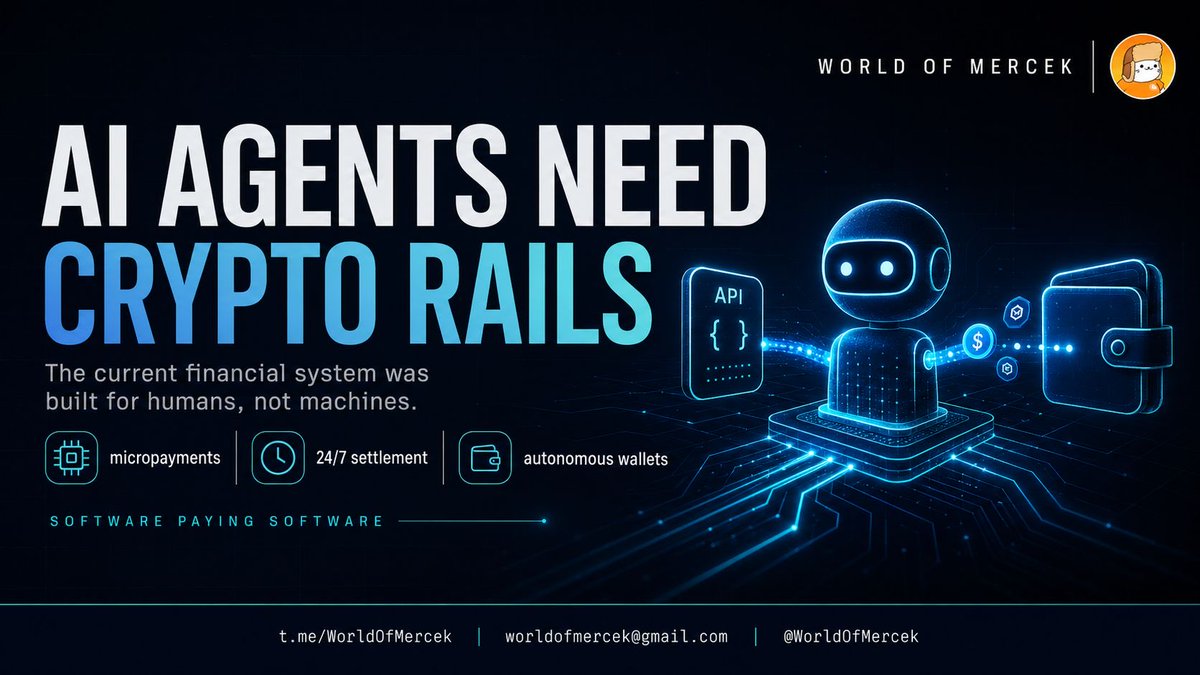
Crypto is not important for AI agents because it sounds futuristic.
It is important because the current financial system was never built for machines.
AI is slowly moving from chatbots to agents that can search, decide, negotiate, execute, and complete tasks on our behalf. But the moment those agents need to pay for something, they hit the old world.
Bank accounts. Permissions. Settlement delays. Card rails. Business hours. Fees that make no sense for software.
That is the bottleneck.
Think about how an agent actually works.
If an AI agent is planning a trip, it may need to connect to flight data, hotel systems, weather APIs, mapping services, payment providers, and maybe dozens of other tools.
Each of those services can require tiny payments.
Not $50 payments.
Sometimes fractions of a cent.
The problem is that traditional finance was designed for humans, not for software making thousands of small decisions in seconds.
A $0.001 API call does not work well with a payment system that charges fixed fees, waits for settlement, closes on weekends, or needs human approval.
Machines operate in milliseconds.
Banks operate in business hours.
That gap is where autonomy breaks.
Crypto fixes part of this because it gives agents something the old system cannot really offer them:
A wallet they can control.
Payments that can run 24/7.
Settlement without asking permission from a bank.
Micropayments that actually make economic sense.
Smart contracts that can enforce rules between machines without trust.
This is why the AI agent economy and crypto feel naturally connected.
If agents are going to rent compute, buy data, pay APIs, hire other agents, settle tasks, and move value between systems, they need financial rails that move at software speed.
The future economy will not only be humans paying humans.
A growing part of it will be software paying software.
And if that is true, then crypto is not just another asset class in this story.
It becomes the payment layer for autonomous machines.
The more AI agents become real, the more obvious this gets.
Code does not sleep.
Agents do not wait for banking hours.
And the economy they are about to create will need rails that were built for that reality.
The bottleneck for AI agents was never compute but verifiable proof of computation.
→ @NaraBuildAI built a Layer 1 around that specific problem.
PoMI (Proof of Machine Intelligence) means an agent doesn’t merely solve a challenge and claim credit, it submits a ZK proof on-chain.
The chain verifies it and $NARA goes to the wallet.
→ Mathematically unfakeable.
@BitgetWallet added native Nara Chain support today without manual network config.
Nara Skill installs in Claude Code, Cursor, Codex, Amp… wherever you’re already building.
→ No staking to participate
→ 7.77x boost for early participants
→ 20 NARA for connecting X

Trading and talking about trades have always been two separate things.
You think in one place, execute in another, then go back to explain it.
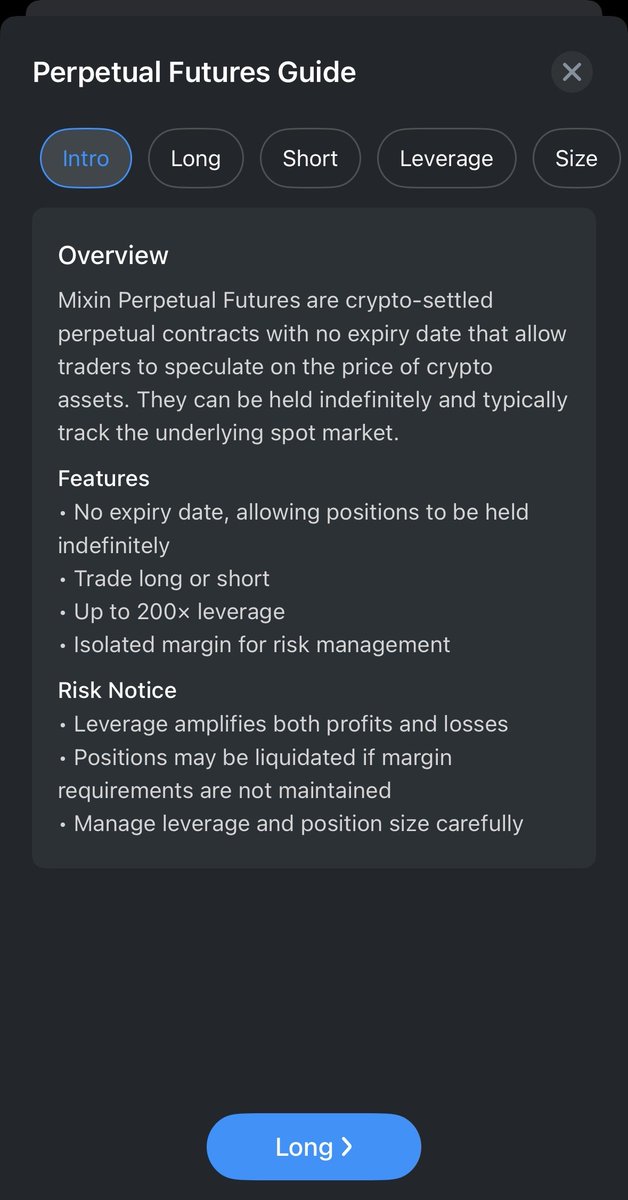
@MixinMessenger perps is the first time i’ve seen both collapse in the same environment 👇🏻
1⃣ Execution in place
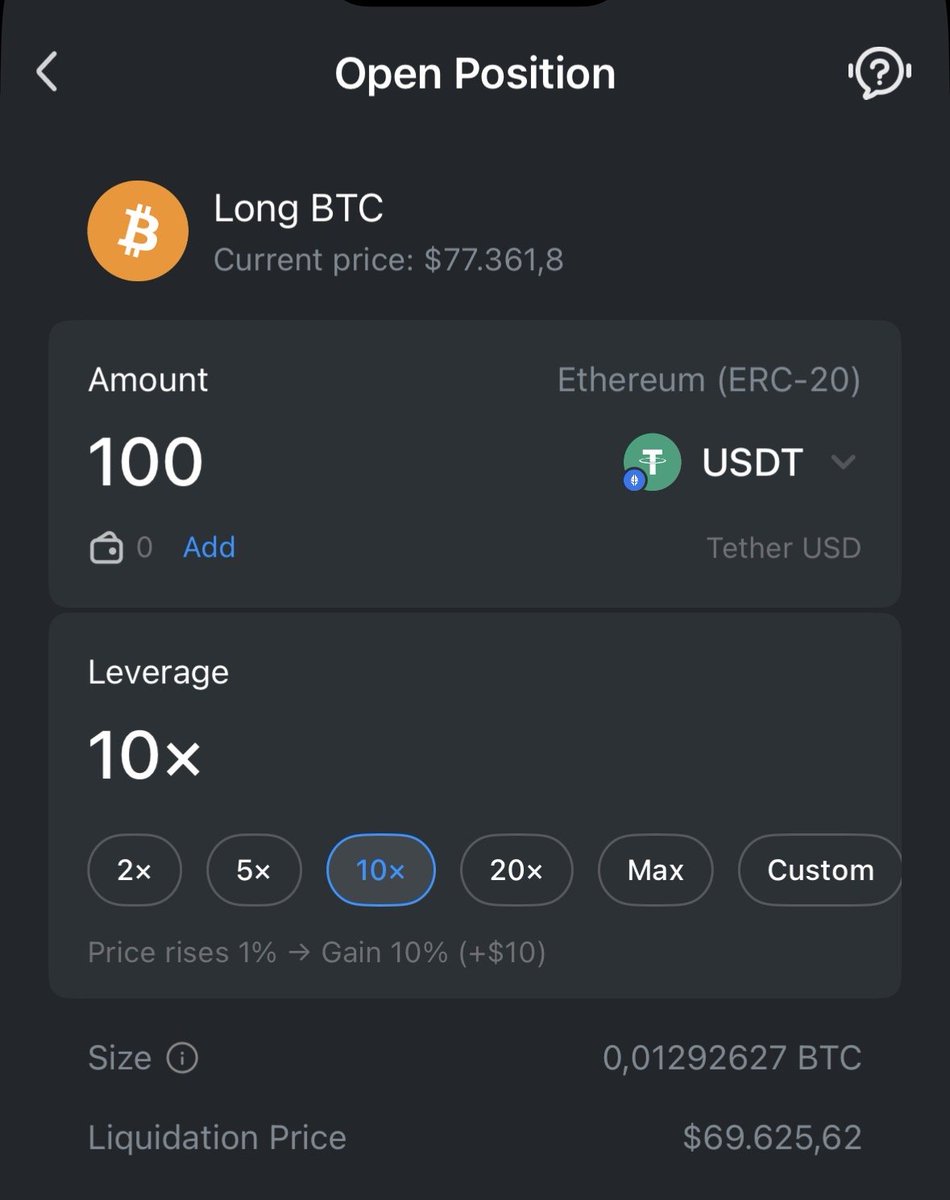
What hits first is how little friction there is between thinking about a trade and actually placing it.
You don’t need to jump between tabs or loading different panels to check size and pnl.
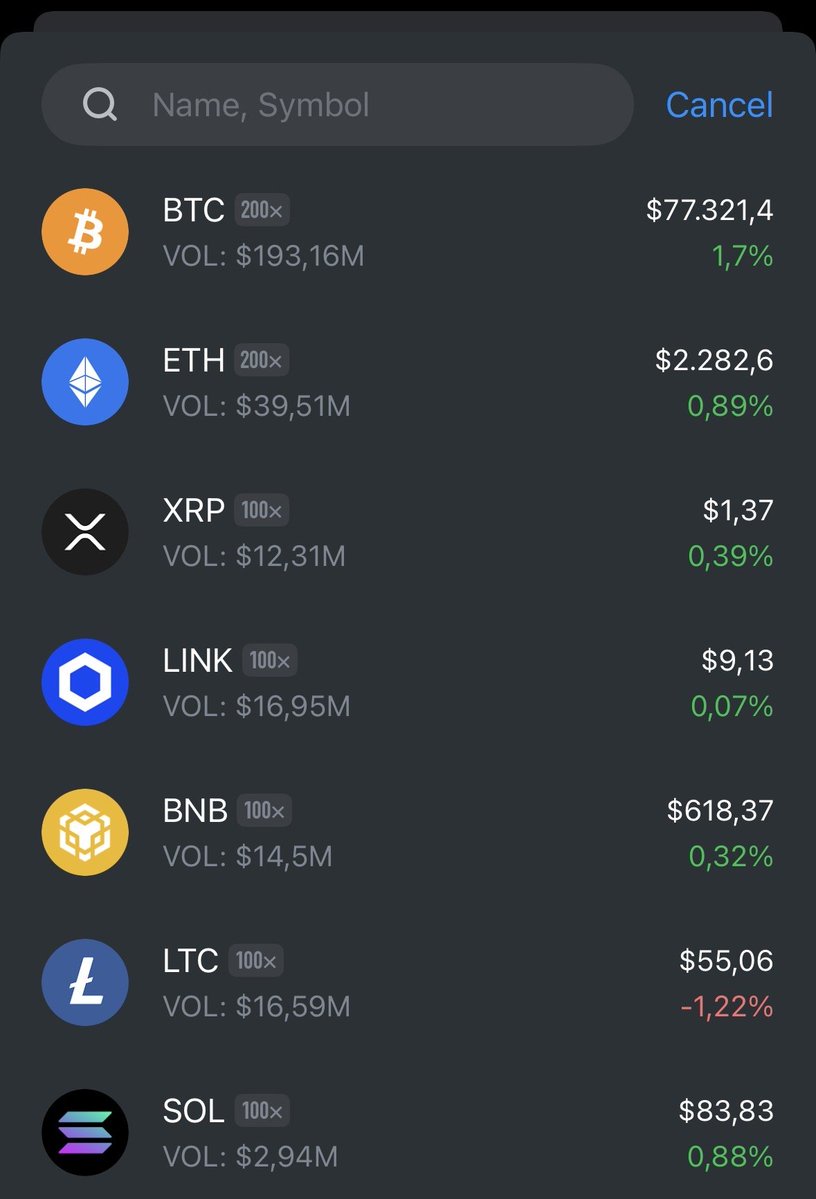
You pick the pair, set leverage, confirm and you’re in.
It could sound basic, but most platforms still break that flow with too many steps.
Here it feels closer to how people already think and act when trading.
2⃣ Where ideas live
The main difference with other platforms is how trading and conversation sit together.
You can share a position directly into a group, others see the exact setup, and react to it in real time.
And from there people can follow, copy, or challenge it instantly.
It removes that lag between seeing something and acting on it.
3⃣ Liquidity underneath
You don’t really notice it at first, but the system pulls liquidity from different sources in the background.
So, you’re not locked into one venue or one pool, you trade, and the routing happens behind the scenes.
That matters more over time than it looks
especially when size increases or markets get messy.
4⃣ Control stays yours
Everything runs on a self-custodial setup.
Funds stay separated from trading, no central account holding your assets.
You sign and execute, but ownership doesn’t leave your wallet.
Also noticed how much they lean into privacy
not just for storage, but for communication too.
To me, feels designed for people who care about that layer, not only returns.
5⃣ What this changes
After using it for a bit, the product itself isn’t the main point.
It’s the idea that trading becomes something you do with others, in real time, without leaving the environment.
It’s a different mental model: less “open chart → trade → close app” and more continuous interaction.
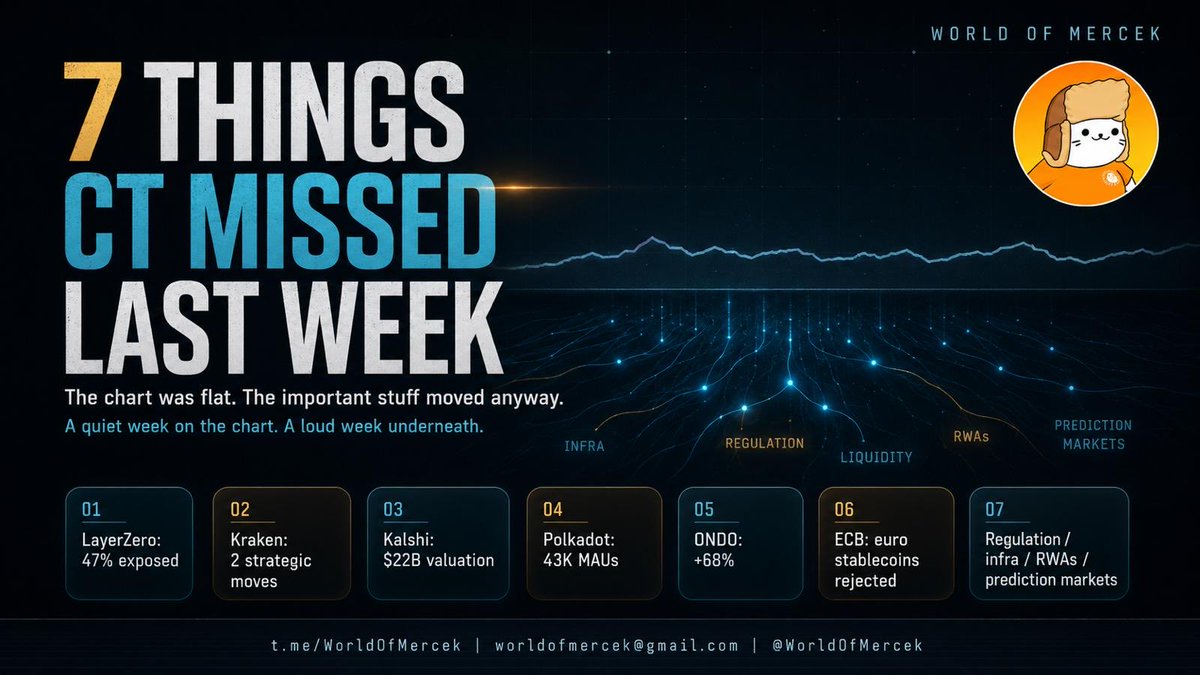
Seven things happened last week that most of CT missed because the chart was flat.
Usually the time when the important stuff moves 👇
🗞 LayerZero admits a mistake
Three weeks of blaming @KelpDAO. Then Friday: "We made a mistake."
47% of all @LayerZero_Core OApp contracts ran the same 1/1 DVN configuration that enabled the $292M Lazarus Group attack.
The apology came with changes:
→ 1/1 configs banned
→ Defaults migrating to 5/5
→ Multisig threshold going from 3-of-5 to 7-of-10
---------------------------------------------------------------------------------------
🗞 @krakenfx went shopping, twice
@Payward acquired Hong Kong payments firm Reap for $600M and filed with the OCC for a US federal trust charter in the same week.
One move buys stablecoin payment rails across Asia.
The other, if approved, makes Kraken one of the first crypto-native firms with a federally chartered trust company: custody and banking services without state-by-state licensing.
---------------------------------------------------------------------------------------
🗞 @Kalshi is now worth $22 billion
$1B Series F confirmed. Coatue led, Morgan Stanley, Sequoia, a16z and Paradigm participated.
→ Valuation doubled from December. Doubled again from October
→ Institutional trading volume up 800% in six months
→ Annualized volume from $52B to $178B
The pitch moved from election betting to institutional hedging: event contracts as a tool for fund managers expressing views on Fed decisions and regulatory outcomes.
Bernstein projects $240B in sector volume in 2026, up 370% from 2025.
---------------------------------------------------------------------------------------
🗞 @Polkadot's crisis is impossible to ignore
Monthly active users fell from 200k in December 2024 to 43k today.
→ DeFi TVL across all parachains sits at $81M: down from $376M on Hydration alone only eight months ago.
→ $DOT trades at $1.22, down 97.8% from its $55 all-time high.
→ Centrifuge migrated to Ethereum.
→ A Hyperbridge exploit in April minted 1 billion bridged DOT tokens in a single transaction.
The JAM upgrade could reshape the protocol entirely. But it won't launch before late 2026 at the earliest.
---------------------------------------------------------------------------------------
🗞 $ONDO surged 68%
US legislative momentum on tokenization drove the move for @OndoFinance token.
@Bitwise absorbing @SuperstateInc's $267M tokenized fund the same week is the same signal from a different angle: traditional asset managers are acquiring tokenized infra rather than building it.
Consolidation phase of a maturing market.
---------------------------------------------------------------------------------------
🗞 The ECB said no to euro stablecoins
Lagarde told the European Parliament that private euro stablecoins aren't the answer: Europe should build public infrastructure instead.
That position sits in direct tension with the US GENIUS Act, which explicitly enables private stablecoin issuance.
The regulatory divergence between the US and EU is widening.
Where that asymmetry lands over the next 24 months will shape where capital and developers flow.
---------------------------------------------------------------------------------------
✍️ Closing note
Polkadot raised a quarter billion dollars in 2017 to build the future of blockchain infrastructure.
Last week it had 43,000 monthly active users.
Kalshi raised a billion dollars last week alone.
Crypto has a way of humbling the consensus very publicly...
Save this post and check back in five years!
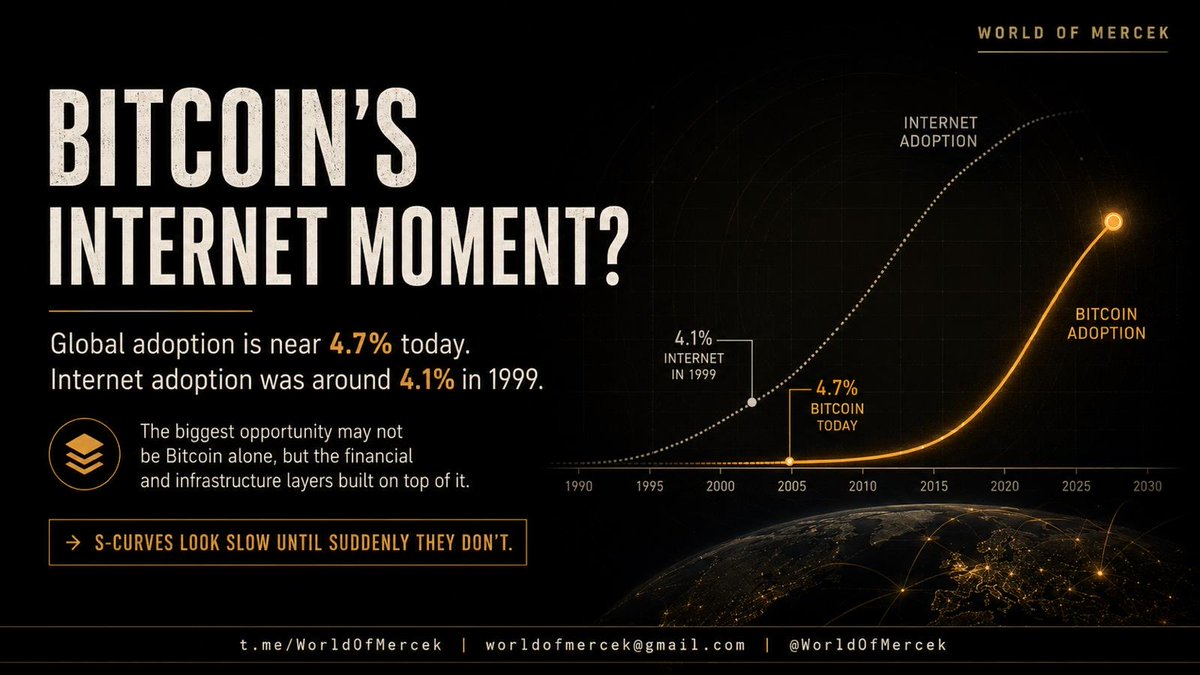
Bitcoin adoption is sitting around 4.7% globally today.
Internet adoption was around 4.1% in 1999.
That comparison is hard to ignore.
Back then people said the internet was a bubble. Nobody would use it in daily life. It was “just for tech nerds.”
Then the dot-com crash happened.
Most companies died.
But the internet itself didn’t.
And what came after created some of the largest companies in modern history.
Amazon. Google. Apple.
That’s the part most people misunderstand.
The biggest value wasn’t just the internet itself.
It was the financial, software, and infrastructure layers built on top of it.
Feels similar with Bitcoin.
Maybe the bigger question is no longer whether Bitcoin survives.
Maybe the real question is:
What gets built on top of a globally adopted digital monetary network?
Because S-curves always look slow at the beginning.
Until suddenly they don’t.
While all debates stablecoin market share, USD1 made the more consequential move.
Native TIP-20 issuance on @tempo.
This move makes USD1 the first stablecoin on Tempo without the structural baggage every other one carries.
Wrapper stablecoins are a liability dressed as liquidity.
One bridge exploit and the peg becomes a question mark.
USD1 skips that risk layer entirely, with Chainlink CCIP handling cross-chain transfers on top.
Tempo is pre-TGE, OKX already moved in with native USDT support, and now the first natively issued stablecoin on the chain is politically connected, battle-tested, and already sitting at $4.5B circulation elsewhere.
Full announcement below 👇🏻

For many, @Aptos is still seen and considered as “the fast chain.”
Personally, I think that framing is quickly getting replaced.
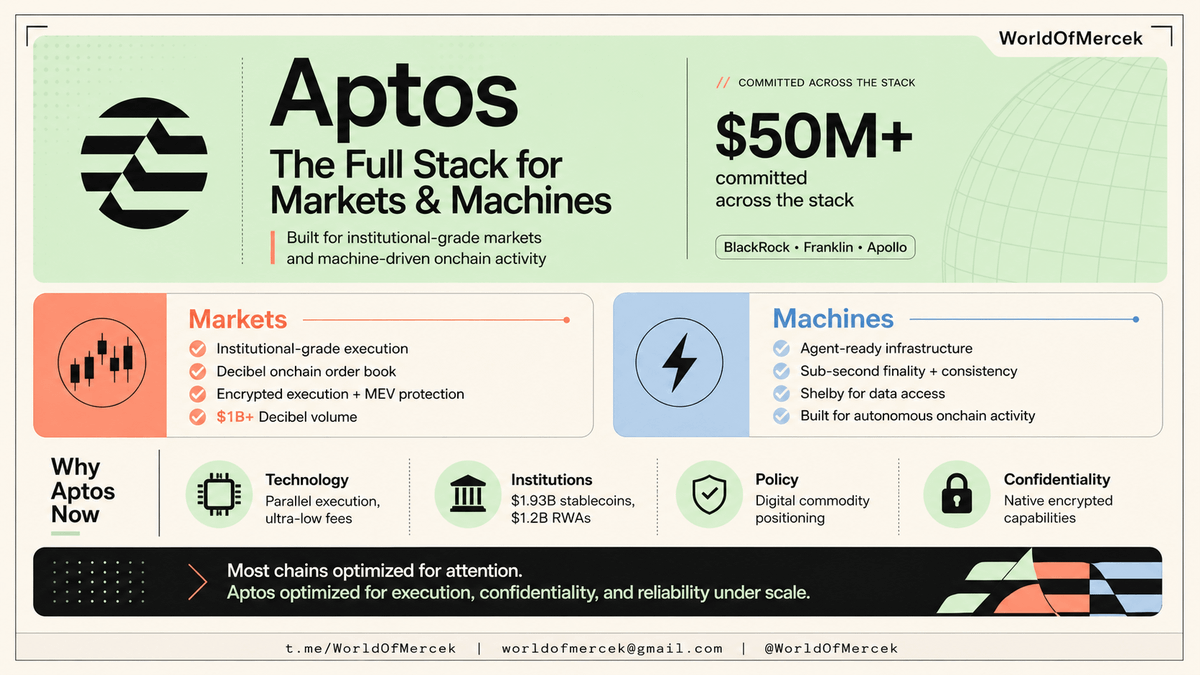
Aptos is focused on positioning itself for two very specific things most chains still aren’t ready for:
→ Institutional-grade markets
→ Machine-driven onchain activity
And honestly, those are probably the two biggest sources of future blockchain demand.
The interesting part is that they spent years building the infrastructure before the demand fully arrived.
Now you’re starting to see the pieces connect:
→ Nearly $2B in stablecoins onchain
→ $1B+ RWAs
→ BlackRock, Franklin, Apollo already involved
→ Fully onchain orderbook infra with Decibel
→ Encrypted execution + MEV protection becoming a real focus
→ AI/agentic workloads through projects like Shelby
Most chains optimized for narratives and user attention.
Aptos seems to have optimized for execution quality, throughput, confidentiality, and reliability under scale.
Bullish af on them.

$292 million drained in a single exploit.
Three weeks later, $300 million pledged to fix it.
What happened in between is the most important story in DeFi this year.
Here is the complete timeline of the "DeFi United", contribution by contribution 👇
🗓 April 18: The Exploit
18:21 UTC: An attacker forges a @LayerZero_Core cross-chain message, tricking @KelpDAO's bridge verifier into releasing 116,500 unbacked rsETH on Ethereum mainnet without a corresponding burn on Unichain.
Within minutes, the attacker deposits 89,567 rsETH as collateral across @aave, @compoundfinance, and @eulerfinance.
18:52 UTC: Aave Guardian begins freezing rsETH across all V3 deployments.
Post-18:21: UTC: Kelp executes FrozenFundsRecover, clawing back 40,373 rsETH into a controlled address.
------------------------------------------------------------------------------------
🗓 April 20: Freezing
Aave Guardian freezes WETH on Core, Prime, Arbitrum, Base, Mantle, and Linea.
The collateral damage starts showing. USDC and USDT utilization rates on Aave spike toward 100% as depositors try to exit.
Borrowing rates for both pools jump from ~3.5% to 14% within 48 hours — automatically, with no committee, decision or call.
Combined $USDC and $USDT supply on Aave falls from $7.65 billion to $3.96 billion in five days.
------------------------------------------------------------------------------------
🗓 April 21: First Movements
The attacker moves 75,701 ETH (~$175 million) to Ethereum mainnet and begins laundering via Thorchain, Umbra Cash, and Chainflip toward Bitcoin.
Lazarus Group (the North Korean hacking collective behind the 2022 Ronin hack and 2025 Bybit hack) is identified as the likely operator.
------------------------------------------------------------------------------------
🗓 April 22: Recovery Start
Arbitrum Security Council moves fast freezing 30,766 ETH (~$71 million) held by the attacker on Arbitrum One.
By doing so, it recovered roughly 25% of the total drained.
------------------------------------------------------------------------------------
🗓 April 23: DeFi United Launches
Five days after the exploit, Aave service providers launch DeFi United.
The stated goal: raise enough ETH to restore the 112,204 rsETH shortfall: the gap between the 152,577 rsETH in outstanding remote-chain claims and the 40,373 rsETH Kelp recovered directly.
First public commitment: Lido proposes contributing up to 2,500 stETH (~$5.7 million).
EtherFi proposes 5,000 ETH: a direct competitor to Kelp in the liquid restaking market, treating this as a shared infrastructure problem.
Stani Kulechov, Aave founder, pledges 5,000 ETH personally. "Aave is my life's work and we're working nonstop to find the best possible outcome for users."
------------------------------------------------------------------------------------
🗓 April 24: First Contrbutions
DeFi United reaches 69,534 ETH (~$161 million) in commitments from 14 contributors.
Contributors confirmed at this stage:
→ Aave DAO 25,000 ETH proposed
→ Stani Kulechov 5,000 ETH personal
→ Emilio Frangella (Aave VP Engineering) 500 ETH
→ BGD Labs (Ernesto Boado) 100 ETH
→ BGD Labs 250 ETH
→ EtherFi 5,000 ETH
→ Lido 2,500 stETH
→ Mantle 30,000 ETH credit facility
→ Golem Foundation + Golem Factory 1,000 ETH combined
→ Renzo $10M+ deployed into Aave V3 markets
→ Kelp DAO 2,000 ETH (Source: The Block)
------------------------------------------------------------------------------------
🗓 April 27: The $300M milestone
Consensys and Joseph Lubin announce 30,000 ETH commitment: the largest single contribution by a non-Mantle participant.
"The Ethereum ecosystem has always been at its best when it moves together."
→ Avalanche Foundation joins. Notable: Avalanche had zero direct exposure to the exploit.
→ Justin Sun and TRON DAO supply $20M USDT to Aave Core V3 as a show of support.
→ Babylon Foundation deposits $3M USDT Aave: $2M to V3, $1M to V4.
→ Circle Ventures begins purchasing AAVE tokens.
→ Compound DAO proposes 1,900 to 3,000 ETH contribution, targeting recovery of 16,776 ETH in exploiter positions on Compound.
→ Solana Foundation and additional unnamed individual contributors join the fund.
Total pledges cross $300 million.
------------------------------------------------------------------------------------
🗓 April 28 / May 1: The legal complication
Aave announces that clearing the attacker's Ethereum and Arbitrum collateral positions would release approximately 13,000 ETH (~$30 million) into the recovery fund.
A US law firm (Gerstein Harrow LLP) files a restraining notice in the Southern District of New York to prevent Arbitrum DAO from redistributing the 30,766 frozen ETH.
The argument: the attacker is linked to North Korea, making the funds potential state assets.
Aave files an emergency motion to vacate the restraining notice.
Its counterargument: theft does not transfer legal title, these are user funds earmarked for victims, and freezing them creates irreparable harm to DeFi markets.
Arbitrum DAO opens a temperature check vote on releasing the 30,766 ETH. Within the first hour: 16.9 million ARB tokens cast in favor, zero against. Voting closes May 7.
--------------------------------------------------------------------------------------
🗓 May 8: Where it stands
DeFi United is approximately 10% short of the ETH needed to fully restore rsETH backing.
Aave TVL has recovered from a local low of $14.2 billion on April 26 to above $15 billion.
The 30,766 ETH on Arbitrum remains frozen pending the court's ruling on Aave's emergency motion.
Pending commitments still needed from: Circle, Ethena, Frax, and Kraken's Ink L2.
------------------------------------------------------------------------------------
💡 The unresolved question
DeFi's largest coordinated recovery effort in history is 90% complete. The final 10% is stuck at the intersection of on-chain governance and off-chain law.
Arbitrum DAO voted near-unanimously to release the funds. A US court filed a restraining notice anyway.
If the court prevails, recovered funds from future exploits can be intercepted before reaching victims.
The entire recovery coordination model stops working: protocols won't freeze attacker funds if doing so makes them legally targetable.
If Aave's emergency motion succeeds, it sets a precedent that user restitution takes priority over state-sponsored asset claims in DeFi recovery scenarios.
Either outcome defines the rules for every exploit that comes after this one.
All tokens that die do it the same way:
No treasury, no protection, but exit liquidity when sentiment change.
@OlympusXReserve disrupt the entire dynamic.
Sell pressure stops being purely destructive as
part of it routes back into the system → strengthens $ETH backing + pays stakers
So, instead of “who sells first wins” it becomes “who stays benefits from others leaving”
Still crowdsale, but at least the design acknowledges how markets actually behave.

Every credit system ever built assumed the borrower was human.
SSN. Employment history. Bank statements.
@kojiru_com had to build the whole thing from scratch for entities that run 24/7, complete hundreds of tasks a day, and have never existed in any financial record.
ACS scoring that starts at zero and compounds with every completed task is a completely different category.
The cold start problem was always the real bottleneck.
Worth giving this thread a full read 👇🏻

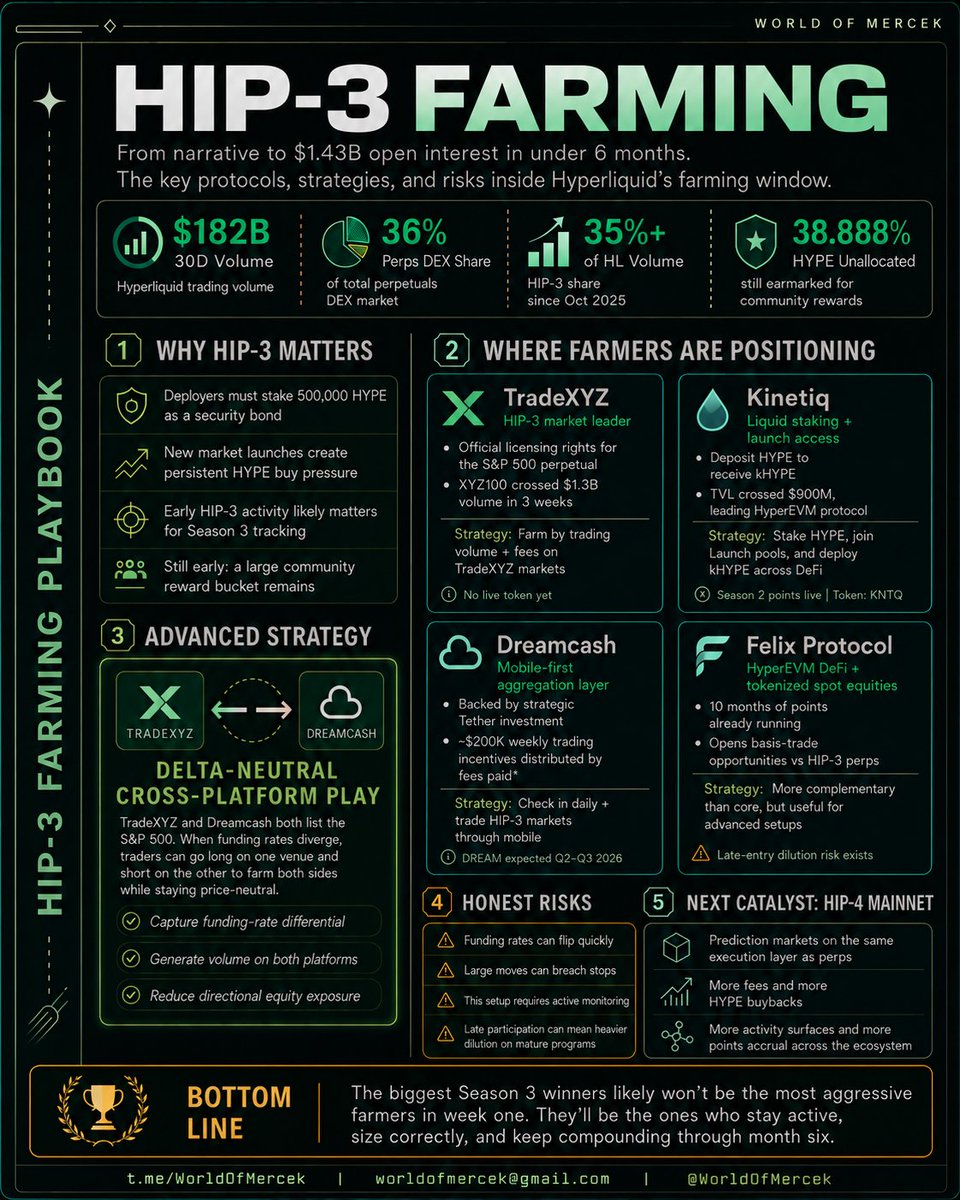
HIP-3 went from narrative to $1.43 billion in open interest in under six months.
If you're not farming it yet, this content break down the complete picture.
What each protocol is building, the farming strategies, and what the honest risks are 👇
1️⃣ Structural importance of HIP-3
@HyperliquidX processed over $182 billion in trading volume in the past 30 days.
It holds 36% of the total perpetuals DEX market. HIP-3 now represents over 35% of all trading volume on the platform since launching in October 2025.
The mechanic that makes HIP-3 interesting for farmers: every deployer must stake 500,000 $HYPE as a security bond.
That's persistent buy pressure on HYPE as new deployers enter, plus direct Hyperliquid Season 3 alignment: early HIP-3 activity is almost certainly tracked for future distribution.
The remaining 38.888% of total HYPE supply is still earmarked for community rewards. You are early.
------------------------------------------------------------------------------------
2️⃣ TradeXYZ
Built by the same team behind Unit, Hyperliquid's spot tokenization layer.
@tradexyz has the deepest moat in the ecosystem: it holds official licensing rights for the S&P 500 perpetual, something no competitor can easily replicate.
The XYZ100 market alone crossed $1.3 billion in volume within three weeks of launch.
The platform hit both its first $1 billion and first $4 billion day in the same week.
Also, the absence of a token is the most bullish signal for farmers: you're farming a protocol with genuine volume and no dilution from live tokenomics yet.
Strategy:
→ Trade actively on TradeXYZ markets
→Volume and fees paid are the most likely farming metrics tracked
------------------------------------------------------------------------------------
3️⃣ Kinetiq
@Kinetiq_xyz is the liquid staking solution where you deposit HYPE, receive kHYPE: a yield-bearing LST that earns staking rewards and unlocks DeFi composability on HyperEVM.
TVL crossed $900 million, making it the leading protocol on HyperEVM.
$KNTQ is already launched and it's the only live token giving direct liquid exposure to HIP-3 markets outside HYPE itself.
Season 2 of the points program is ongoing, meaning you're still farming.
Kinetiq's Launch product goes further.
It lets teams crowdfund the 500,000 HYPE requirement needed to deploy HIP-3 markets, distributing a share of market fees back to kHYPE holders who participate in the crowdfunding pools.
Strategy:
→ Deposit HYPE for kHYPE
→ Participate in Launch pools to earn fee revenue from new HIP-3 market deployments
→ Supply kHYPE to DEX pools like Project X or Hybra to hit multiple airdrop surfaces simultaneously.
------------------------------------------------------------------------------------
4️⃣ Dreamcash
Mobile-first Hyperliquid aggregation layer backed by a strategic @tether investment in February 2026.
Two separate farming programs running simultaneously.
The more interesting one: $200,000 in weekly trading incentives distributed proportionally by fees paid.
Dreamcash currently earns less in weekly fees than it distributes... meaning traders are net positive after fees on volume. That window closes as the platform scales.
The mobile-first design creates structural dilution protection since DeFi farming whales predominantly operate via desktop.
The friction of a mobile interface filters out the capital that typically arrives first and dilutes everyone else's share.
Strategy:
→ Daily app check-ins for points
→Trade on HIP-3 markets through the mobile interface to capture the weekly $200K distribution and stack volume for airdrop eligibility
→ $DREAM token expected Q2-Q3 2026
------------------------------------------------------------------------------------
5️⃣ Felix Protocol
An HyperEVM DeFi hub with 10 months of points program already running.
@felixprotocol is leaning into tokenized spot equities on HyperEVM rather than pure HIP-3 perps.
Different but complementary angle to TradeXYZ and Dreamcash.
The tokenized equity markets create future opportunities for basis trading between Felix's spot equity positions and HIP-3 perpetuals.
Strategy:
→ 10 months of consistent program participation means the farming base is established.
→ Late entrants face concrete dilution risk
→ Useful for basis trading with HIP-3 positions if you understand the mechanics
------------------------------------------------------------------------------------
6️⃣ Delta-neutral play across protocols
The most sophisticated farming strategy currently running in the HIP-3 ecosystem exploits a structural opportunity:
TradeXYZ and Dreamcash both list the S&P 500, and their funding rates frequently diverge.
Long S&P500 on one platform, short on the other, capture the funding rate differential while remaining price-neutral.
You generate volume on both sides which matters for both platforms' farming metrics while also eliminating directional exposure to equity prices.
⚠️ Potential Risks:
→ Funding rates can flip
→ Large price movements can breach stop losses if not managed carefully
→ This is a position that needs active monitoring, not a set-and-forget strategy
------------------------------------------------------------------------------------
7️⃣
HIP-4 mainnet is the next structural catalyst
Prediction markets on the same execution layer as perps means:
→ More fees
→ More HYPE buybacks
→ More points accrual for farmers across HIP-3 protocols
The farmers who will capture the largest Season 3 allocations are the ones still active in month six, not the ones who went hard in week one and burned out.
→ Position sizing matters
→ Active monitoring matters
But the farming window on a platform processing $182B monthly with 38.888% of supply still unallocated is not one most cycles produce.