

🚨 THIS IS ABSOLUTELY CRAZY.
South Koreans are cashing out life insurance policies to buy chip stocks.
Here's what's happening.
People are pulling money out of savings accounts, fixed deposits, and insurance policies to chase SK Hynix and Samsung near record highs.
Savings bank deposits just fell below ₩100 trillion for the first time in 4 years.
Commercial bank time deposits dropped by roughly ₩12 trillion since February.
At the same time, insurance policy surrenders at Korea’s top life insurers jumped 16% last quarter.
The most alarming part is who is buying.
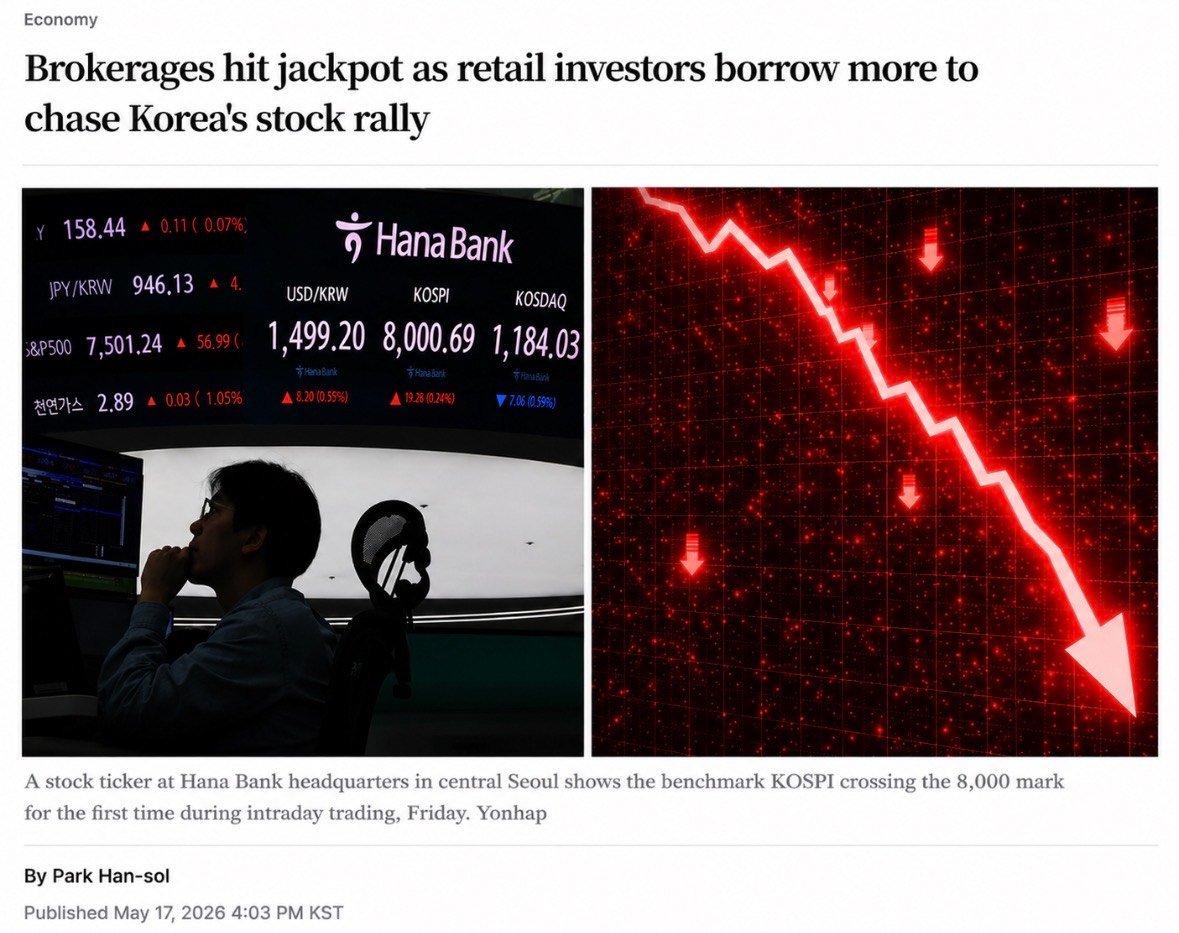
Investors over 50 now hold about 62% of all margin loans at Korea’s top brokerages.
Among people in their 60s, margin debt doubled from ₩3.9 trillion to ₩8 trillion in just one year.
These are people who spent decades saving through deposits, pensions, insurance, and real estate.
Now they are borrowing money to buy semiconductor stocks at record highs.
The entire financial system is slowly being redirected into just 2 semiconductor companies.
At the same time, the Korean government is heavily supporting the chip sector with a ₩33 trillion support package.
That means policy support, retail money, leverage, and market momentum are all flowing into the same trade.
The marginal buyer is no longer investing spare cash.
The marginal buyer is now liquidating insurance policies, withdrawing savings, borrowing on margin, and leveraging existing assets just to stay in the rally.
And this creates real financial risk.
As deposits leave the banking system and insurance policies get surrendered.
• Banks lose funding
• Insurers face higher payout pressure
• Household safety buffers weaken
• Leverage inside the system rises
When the KOSPI dropped 19% in March, leveraged investors in their 60s reportedly lost around 20% on average, and then the market recovered.
But recoveries usually bring even more leverage back into the system.
We have seen this before during:
• US meme-stock bubble in 2021
• China’s margin-fueled crash in 2015
• Japan’s retail equity boom after ultra-low rates
And each one resulted in the bubble pop, and the same will happen again.
From X
Disclaimer: The above content reflects only the author's opinion and does not represent any stance of CoinNX, nor does it constitute any investment advice related to CoinNX.