


Something I had to ask myself some months ago:
> What things can I do today that I won't be able to do in 10 years? maybe in 5 years?
It really clicked.
We now spend our lives trapped in an endless loop of cheap dopamine, busy sitting at a desk in front of a screen, consumed by social media, chasing money at the expense of aliveness, and estimulated by materialistic needs.
That feeling of "I will always have time" is a trap.
You won't.
Life is only squeezed when you understand it's ephemeral.
There's an ever-increasing trend of people spending more time seeing how others live in social media vs. their time actually living their own meaningful experiences.
Information that is purely noise. Endless down scrolling.
And it doesn't matter how much you progress, how well your life is set — the algo will make sure to find people that are doing better than you, forcing the inevitable comparison.
Pure dissatisfaction.
It's just sad.
Never have I seen a rich guy sitting at Cipriani with an AP being happier than a normal guy getting lost with some friends in Indonesia or Brazil.
Don't be the guy that have regrets when you are old. Pursue aliveness.
Also work hard. Be ambitious. Get money. But do it with purpose! That's the key.
Just don't follow the same rat race in a bigger league.
I've seen people who weren't fulfilled at $2k/mo or $50k/mo. At $0 NW or $1M+ NW.
It doesn't matter what you have if you don't know how to use it, or can't use it. The best things in life aren't bought, but lived.
People get in the same rat race, with bigger sums. In the same status games, with more expensive things. The same comparisons, but now more frustrating.
Detach from all of this by asking yourself what you won't be able to do in a few years time. You will start giving more importance to it, caring less about what the world says it matters but it doesn't.
And start doing more of them, today.

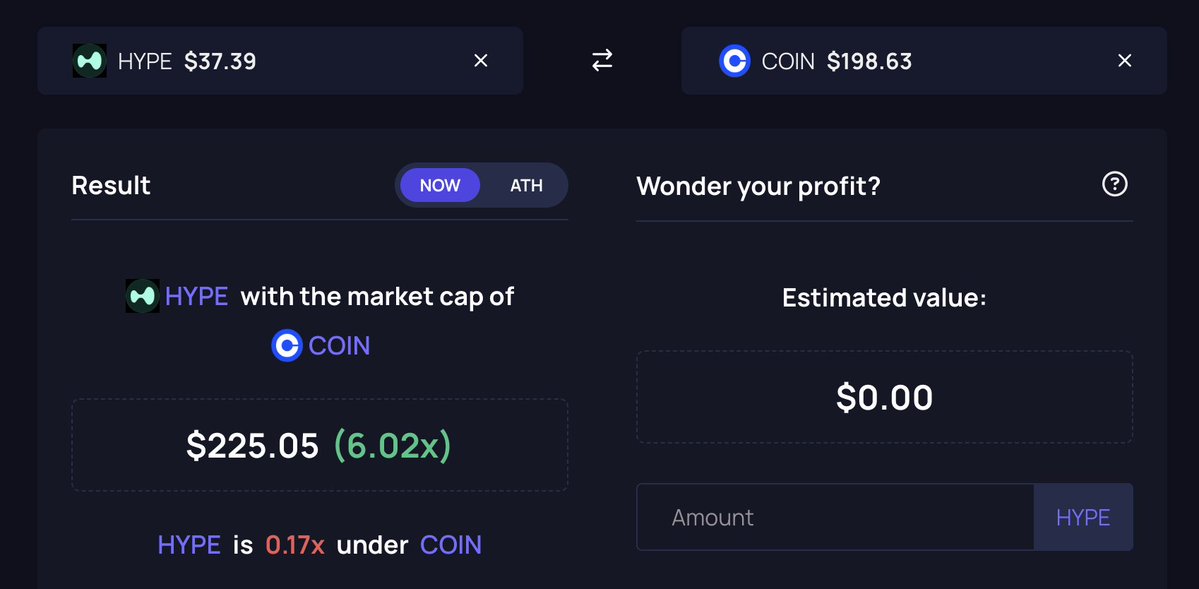
$100-150 $HYPE will come via P/E expansion while Growth Mode remains activated
> Grow TradFi volumes, keep revenue consistent
> Market shapes a growth story: what happens when Growth Mode ends and it makes all this extra revenue?
No possible bear case anymore for "high margins priced to perfection"
See P/E expand.
Still far from CME, Robinhood, or Coinbase, which have, arguably, smaller growth potential relative to the industry and depend mostly on wide-market conditions.

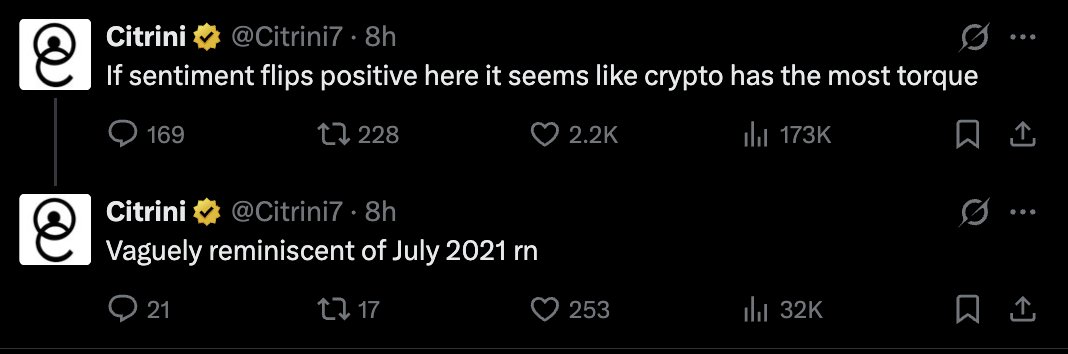

HIP-3 on growth mode is like "mainnet launch" in 2021.
One of the main bear takes on $HYPE on this app was that the margin was already so high that it couldn't grow more, and would only lead to more competition.
However, HIP-3 markets are highly growing on growth mode with very reduced fees.
This contradicts the bear case that many people claimed and, instead, creates a growth story.
> What happens when Growth Mode ends?
This leads to revenue projections that will rerate its valuation, inducing fomo, as the value-capture of Hyperliquid on TradFi markets has no ceiling relative to where it stands now.
And if they replicate in TradFi their position in crypto — where they are the absolute winner with immense margins — the pie could get so big that its current P/E ratio makes it incredibly undervalued, and should put it closer to Robinhood or Coinbase under the same revenue generation.
$HYPE has been a defensive asset during this crypto winter, showing resilience of revenue and constant buybacks.
But HIP-3 with Growth Mode makes it again a growth story, much more appealing than ever before.
No critic can now argue that their margins are close to perfection. All the opposite — we are far from that.


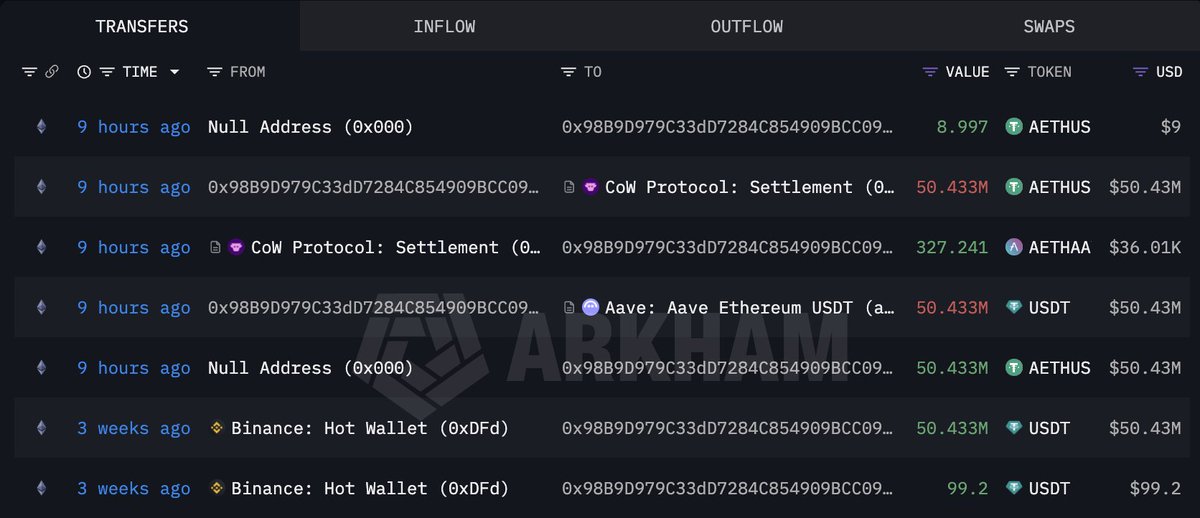
did you know that if you made this swap on Near Intents with Confidential Mode, no one would know


as someone who is close to the team and has seen this being built, I can say this is likely the biggest upgrade to the @SigmaTrading router since it launched years ago.
every trencher here uses like 3 or 4 different trading bots/terminals. Each for a specific thing.
and when a
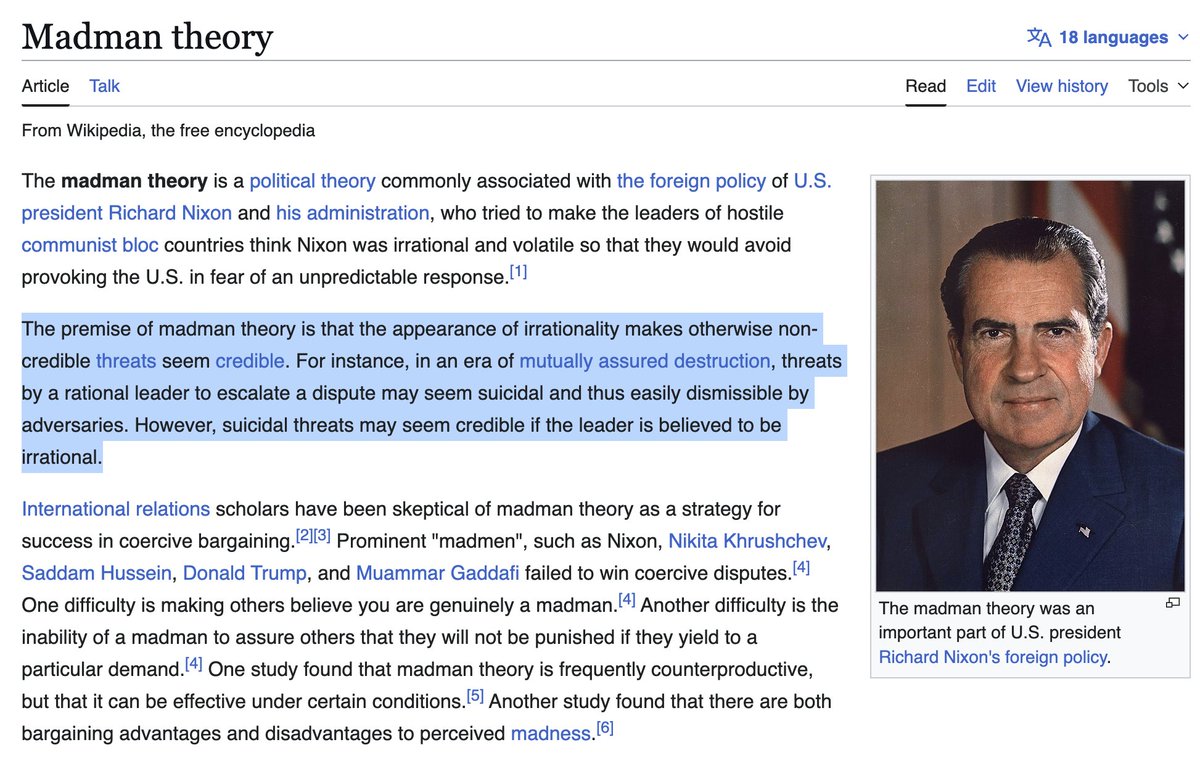
the "Madman Theory" popularized by Nixon is one of the main frameworks of the ongoing conflict between US, Israel, and Iran
everyone sitting at the table is adopting this posture
> this theory says that the appearance of irrationality makes non-credible threats as credible and adversaries tend to back off
it's a case study of game theory, especially under mutually assured destruction regimes
although effective, it assumes the other side is rational enough to flinch. When one player does it, it works well.
but everyone here is playing to be the madman and that's why we all see things that we consider irrational from all fronts
everyone is rational at their own game, while playing irrationality to the eyes of the enemy
using a poker analogy – this is an escalating bluffing game, where your bets go higher to keep playing, to see the next card.
but what happens if you are caught bluffing?
everyone goes at you with everything they have; the whole table turns on you.
that's the risk everyone is at right now
and because no one wants to get caught, you have to wonder: how far is each side willing to extend the bluff?
How much collateral damage are they willing to absorb just to maintain the appearance of being the craziest one at the table?
Who has the capabilities to last longer, and out-bluff the other?
Once irrationality escalates, who losses the most when it's revealed that irrationality was a mask?
Who can move forward with his bluff given no other chance, and can just swallow it?
I find this framework fundamental to understand, whether you are close to the conflict or you are trading markets.
as someone who is close to the team and has seen this being built, I can say this is likely the biggest upgrade to the @SigmaTrading router since it launched years ago.
every trencher here uses like 3 or 4 different trading bots/terminals. Each for a specific thing.
and when a new chain, dex, or launchpad get to market, you need to look for the 5th tool that supports it
Sigma now eliminates all this hurdle in a space that gets more and more fragmented, where the opportunity to make a profit resides on whether you are truly (truly) early, or have some advantage.
> it means that now it can support any chain, dex, launchpad, and launch mechanism AS SOON AS they are released
immediate support for all new stuff
next time something new launches just go try sigma, and don't miss the next big runners wherever they are

The Fat Protocol thesis is dead.
Long live the Sovereign App thesis.
For years, L1 valuations were built on a simple bet: launch a chain, attract devs, hope someone builds something people actually use.
That era is over.
L1s will only win by building the product themselves.
Hyperliquid didn't launch a chain and pray for a DEX to show up. They built the best perps DEX in crypto — which needed its own specific infrastructure.
–> The revenue capture doesn't come from gas, but from fees generated because people want to use the purpose-built app.
@NEARProtocol is the closest thing to date.
NEAR Intents is generating real protocol revenue, while the chain serves the product — a product that could only be built thanks to the tech specs of Near Layer 1.
This is the Sovereign App thesis:
Build a product with real PMF. Generate organic revenue. Own the full stack — app and infrastructure fused into one revenue engine. Then builders will come to keep enhancing your product.
Hyperliquid pioneered this, and it's the right approach.
The old L1 playbook was horizontal: be a platform, rent out blockspace, celebrate TVL (in most cases, dead TVL), and hope that each app on top gives you enough revenue.
Only two smart-contract platforms successfully achieved this: Ethereum and Solana.
However, all other L1 that is launching today with the "fat protocol thesis" and "horizontal playbook" aren't getting nowhere, as well as old L1s that aren't adapting, because there's no need for them.
Not because they aren't good enough but because there's so many L1s and L2s that blockspace got commoditized and became basically free.
People are now only willing to pay for products, useful products.
The Sovereign App playbook is vertical: own the product, own the user, own the revenue.
The winning chains will be defined not by their blockspace demand — but by the products that fill it.


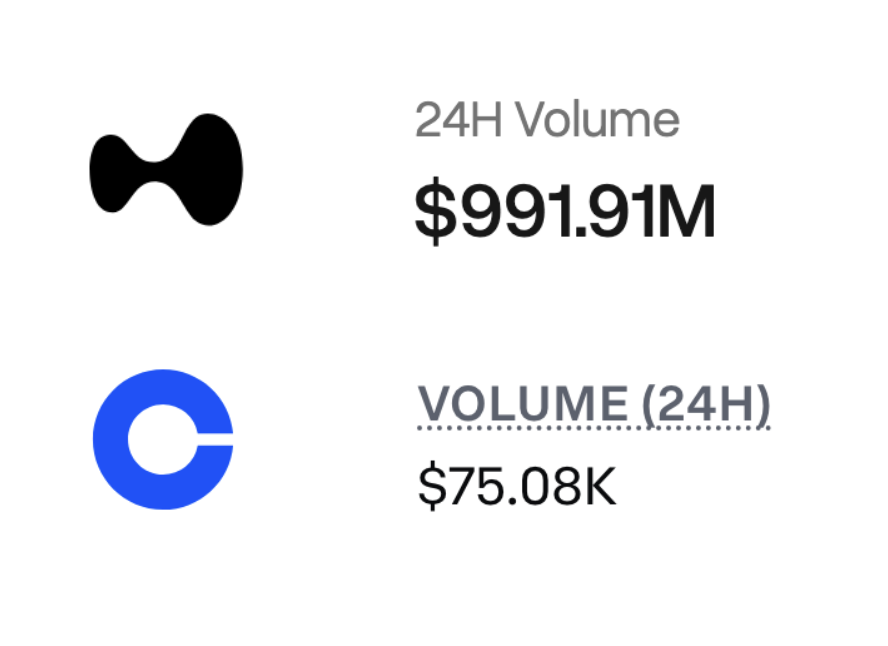
how did we go from
2021: if you sell before 100M you are a jeet, crypto is the place for 1,000x runs, generational wealth
to
2026: how to bundle a coin to make a few bucks before it reaches 100k mcap

ATTENTION: NEAR Intents is now integrated into Brave Wallet, bringing completely new cross-chain connections to @brave’s 110M+ monthly active users.

A wise man one said:
"If socialists rely on the poor for votes, what incentive do they have to eliminate poverty?"
If socialism draws its support from those it claims to liberate, the liberation itself becomes a threat to the movement.
And therefore cannot be solved, only perpetuated.
This is what's currently happening.
Why do socialists in western countries hate so much people who leave to other countries — especially with low tax — but also give so much public benefits for free to illegal immigrants who, of course, pay no tax?
While collapsing services that are already not working properly for the ones who pay?
They are clearly destroying what it used to be a prosperous system. No one that makes a bit of money uses public healthcare in Spain anymore because it sucks. Good luck being attended before a 5-month waiting list.
And it keeps getting worse.

if you measure
• the input time into an agent like openclaw (ie. the time you dedicate to set it up, fight it, correct it, edit his deliverables to the desired quality, etc)
• and the output time (ie. the time the agent actually saves for you)
defined as an efficiency factor:
AI_efficiency = output_time / input_time
I am pretty sure that AI_efficiency tends to 0 for 99.9% of the people that have ever used it.
This means today, and for the foreseeable future, humans are spending more time on their agents than the time the agents are saving to their humans while humans call it productivity boost.
*this does not account for things like coding, cowork, or simply web-based llm work.

among all the AI hype, apart from a couple of outliers and opportunistic wrappers, is there anyone that has massively benefitted from these yet — ie. change your life type of thing
apart obvs from influencers that profit off of promoting how amazing their 17 agents that are running doing god knows what?
not simply improve productivity, finish tasks quicker, get better info, iterate coding faster, launch more mvps, etc. That, we've all done i think
lots of people have vibe coded cool stuff like custom trackers suited to personal needs, some even some micro SaaS, and experimented with a cron job that gives you a briefing in the morning or a finalized presentation that you didn’t need anyways
i guess people posting AI slop on X — still surprising to me how those get millions of views — are making good money
but it feels like today there’s more people making money off selling how amazing AI is instead of actually using AI
everyone is getting more efficient, but personally don’t know many who have gone from 0 to 100 using AI before having barely nothing

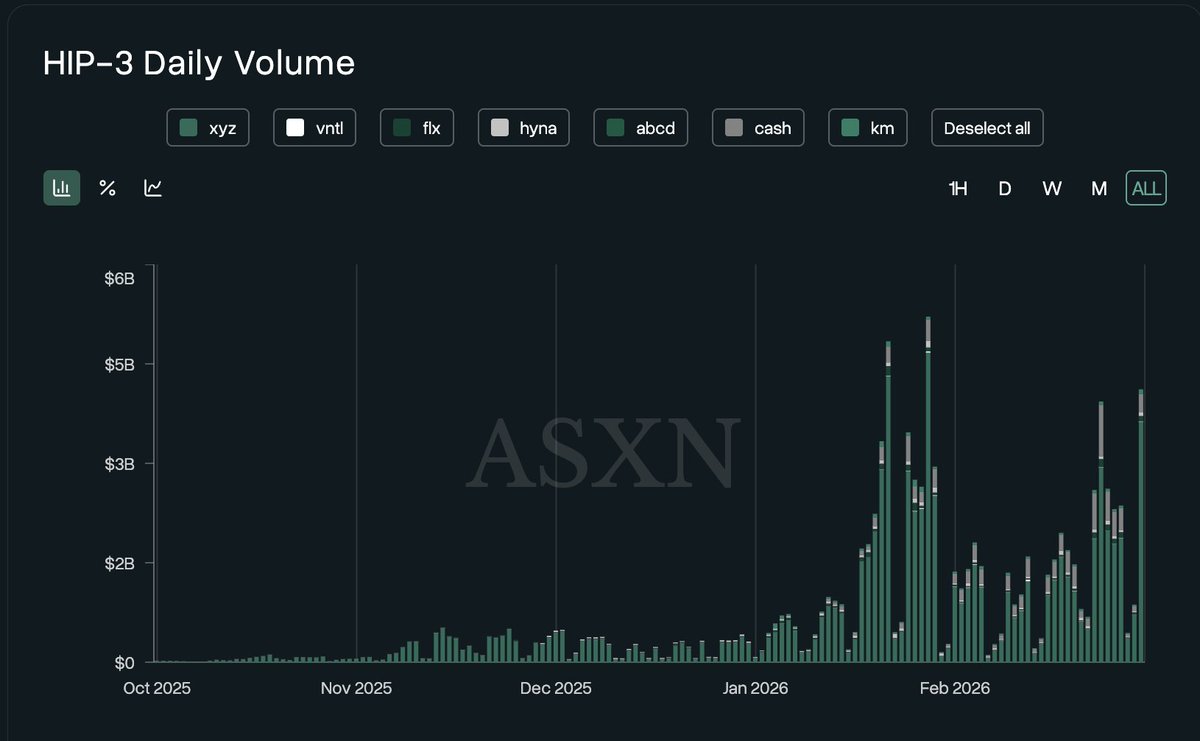
And among all that volatility, the same beneficiary.
Hyperliquid.
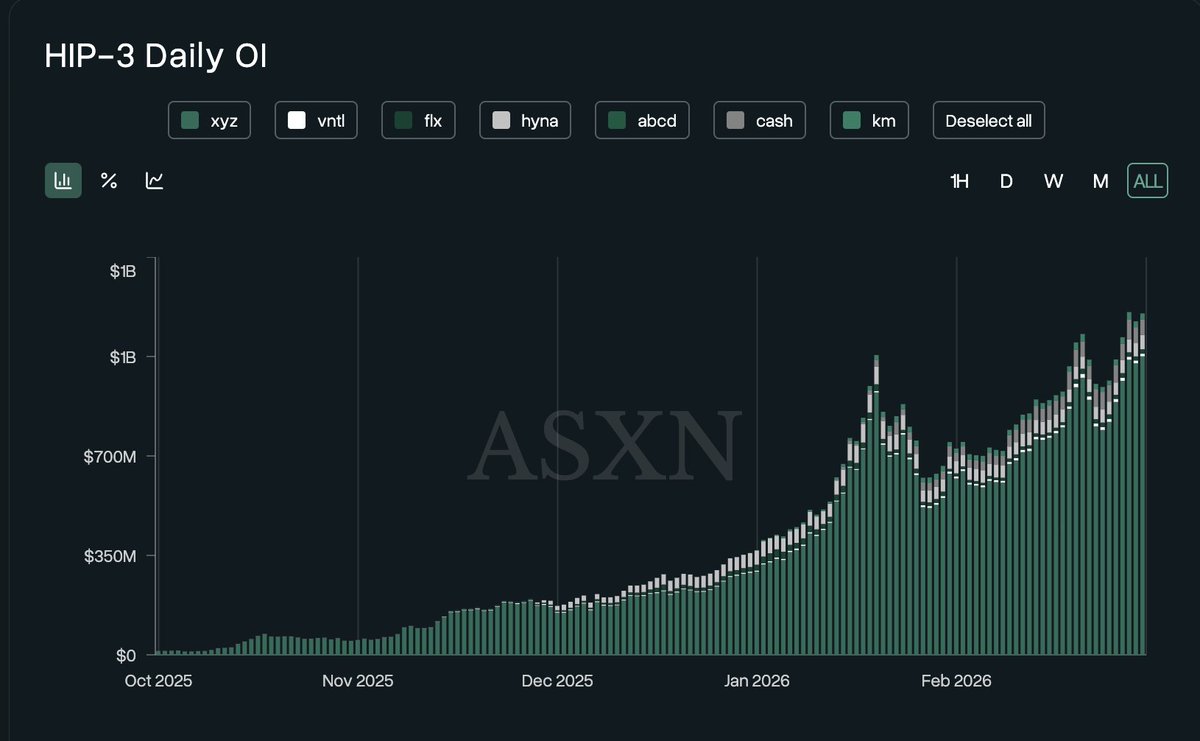
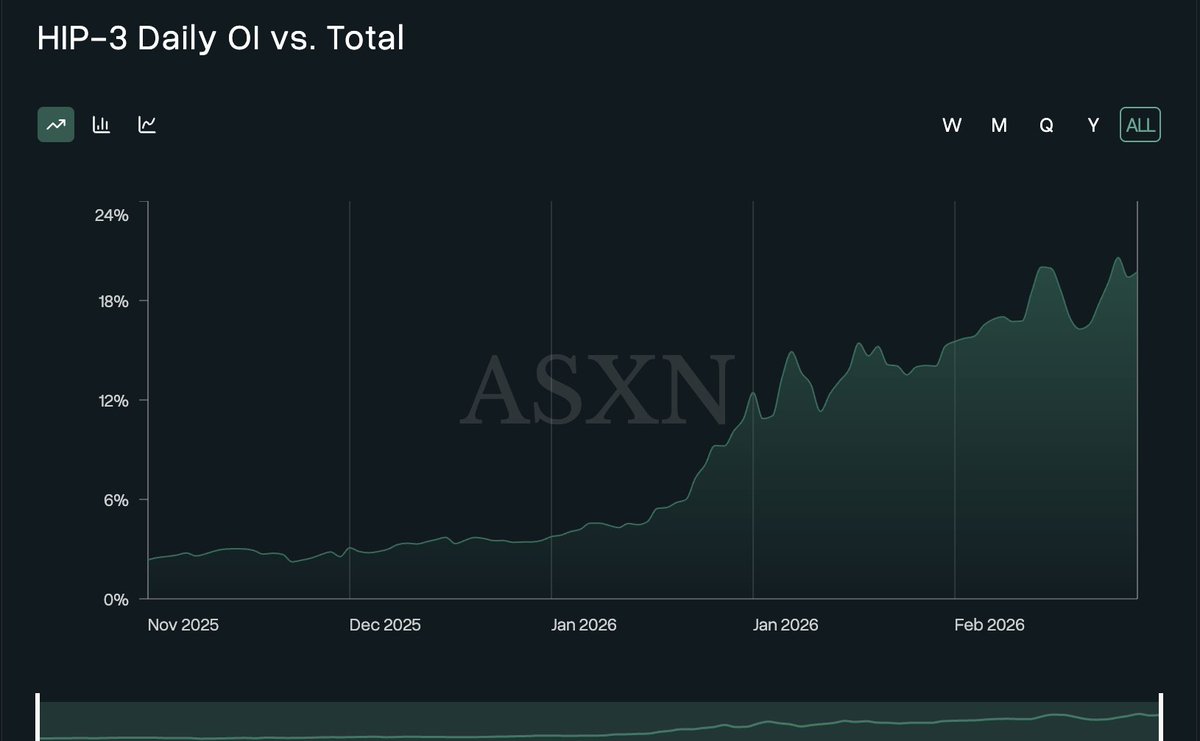
During the previous ATH of HIP3 volume on Feb 5th, OI/Total ≈ 11%
Today, OI/Total ≈ 20% — a staggering 2x in 30 days.
The ratio Vol(hip3) / OI(hip3) dropped 60% from ≈ 8.3 on Feb 5th to ≈ 3.4 today (less is better).
Over time, HIP-3 markets are proving persistent activity, rather than the classic short-lived hype cycle of other products.
This is not a trend you want to fade.





>be Microsoft
>invest billions in OpenAI
>get a stake of 27% valued at $200B
>then invest $5B in Anthropic at $350B for 1.4% ownership
>use Claude for Microsoft’s flagship suit of products to 400M users


The fact that Microsoft has a 27% stake in OpenAI yet uses Claude to power Microsoft 365 says a lot.




Everyone that mocks UAE and the Gulf countries don’t realize the Europe is being invaded from within, little by little.
